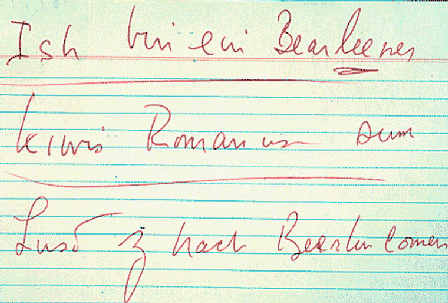
After five years, President Obama returned to Berlin today and delivered another “historical” speech for about 4000 invited guests and probably millions watching him on TV. A bit boring (since we had already heard Mayor Klaus Wowereit and Chancellor Angela Merkel evoking the famous quote by John F. Kennedy from fifty years ago), also Obama referred to the young and charismatic president of the Cold War who took pride in the words “Ich bin ein Berliner”.
But more importantly he quoted a central admonition by Kennedy,
“So let me ask you […] to lift your eyes beyond the dangers of today, to the hopes of tomorrow, beyond the freedom merely of this city of Berlin, or your country of Germany, to the advance of freedom everywhere, beyond the wall to the day of peace with justice, beyond yourselves and ourselves to all mankind.”
Did he address the Germans and their government here? It is Obama who seems to be constantly in conflict with his own standards. Many have lost any hopes that this talented speaker will ever live up to his own aspirations. What can we do with these sentences?
“[…]I drew inspiration from one of our founding fathers, James Madison, who wrote, ‘No nation could preserve its freedom in the midst of continual warfare.’ James Madison is right — which is why, even as we remain vigilant about the threat of terrorism, we must move beyond a mindset of perpetual war. And in America, that means redoubling our efforts to close the prison at Guantanamo. It means tightly controlling our use of new technologies like drones. It means balancing the pursuit of security with the protection of privacy.
And I’m confident that that balance can be struck. I’m confident of that, and I’m confident that working with Germany, we can keep each other safe while at the same time maintaining those essential values for which we fought for.” (Emphasis added.)
When did Obama ever fight for those indeed essential values?
“Our current programs are bound by the rule of law, and they’re focused on threats to our security — not the communications of ordinary persons. They help confront real dangers, and they keep people safe here in the United States and here in Europe. But we must accept the challenge that all of us in democratic governments face: to listen to the voices who disagree with us; to have an open debate about how we use our powers and how we must constrain them; and to always remember that government exists to serve the power of the individual, and not the other way around. That’s what makes us who we are, and that’s what makes us different from those on the other side of the wall.”
There are plenty of reasons for distrust. And how does that fit to relentless prosecution of whistle-blowers like Bradley Manning and Edward Snowden? Who else is digging truth? Quoting Martin Luther King Jr. in this context, that “injustice anywhere is a threat to justice everywhere” is, of course, indecent.
Once again, Kuwait’s Constitutional Court has dissolved Parliament on Sunday and called for new elections. The same took place on June 20, 2012, when the top court annulled an opposition-dominated Parliament. The Amir, Sheikh Sabah al-Ahmed al-Sabah, subsequently amended the electoral system seeking a more pro-government assembly in snap elections of December 2012. The election was boycotted by the opposition and, for a short time, the Arab Spring seems to have occupied the tiny oil-rich emirate. They had cried foul as regards the constitutionality of the change to the voting system which had been ordered by the Amir. Meanwhile media again report rather on harsh punishment of traffic violators and a scandalous campaign for deportation of expatriates, Kuwait’s Asian work force, than on the lingering parliamentary crisis.
“[t]he Constitutional Court made its ruling [dissolution of Parliament] after throwing out an opposition challenge to changes to the electoral system decreed by the emir, hereditary ruler of the oil-exporting country, head judge Youssef al-Mutawa told reporters.
“The case has international importance because political stability in Kuwait […] has traditionally depended on cooperation between the government and the elected parliament, the oldest and most powerful legislature in the Gulf Arab states.”
The Amir’s decree regarding the voting system was not challenged, al-Mutawa told reporters. So, how powerful is a toothless parliament?
Iran’s Supreme Leader Ayatollah Ali Khamenei is of course smart, too. Hassan Rouhani’s victory was inevitable. At 50.7% it would have been a so often exercised easy task to give clandestine orders to the Interior Ministry to round down his votes a bit and let him run next Friday against Tehran’s mayor Mohammad Baqer Qalibaf, something which had functioned very well in 2005 when Mahmoud Ahmadinejad captured a landslide victory of 64% in the second round. His competitor then was Hashemi Rafsanjani; and then number three Mehdi Karroubi spoke openly of election fraud.
But this time, the Grand Ayatollah saw plenty advantages of not interfering, not yet. The high turnout in excess of 72%. The clear result with its large margin (Qalibaf got just 16%, Saeed Jalili only 11%). That Iran may be portrayed, from now on and forever, as shining democracy. Well, the only democracy in the Middle East. (Who considers apartheid Israel a democracy any longer?) Disciplined citizens have expressed their determined will, even somehow in opposition to the hardliners’ establishment. The world looked at Tehran today with pleasure. Will the nuclear issue eventually be solved? The future can only be better. A great day for everybody. That’s what Ali Khamenei had probably in mind.
The question remains, what Barack Obama may make of this. He has just considered a no-fly zone for Syria, Iran’s strongest ally in the Middle East. It may now be president-elect and former nuclear negotiator Hassan Rouhani’s turn to reach out for better relationships between the arch enemies. No kidding, isn’t it high time to actually go to Tehran?
That democracy actually works in Iran might be considered an outrageous claim of apologetic defenders of the regime in Tehran. But Iranians are clever. This time, four years after Mahmoud Ahmadinejad’s questionable re-election(I have never seen convincing data which ultimately would prove that he had stolen the election, though) it seems so that “moderate” “reformist” Hassan Rouhani, who had been leading in the latest polls at not more than 23.3%, may have won the presidential election in a landslide victory already.
The Ministry of Interior is much more hesitant in reporting results this time, for obvious reasons. It seems so that a decision has to be made whether a second round on Friday next week is needed or not.
President Barack Obama visits Berlin on Tuesday and Wednesday next week for the second time. Five years ago the then campaigning presidential hopeful gave one of his numerous “historical” speeches in front of the Victory Column (commemorating the Prussian victory in the Franco-Prussian war of 1870-71. By the way, Chancellor Angela Merkel had discouraged the young candidate to speak at the similarly deeply symbolic Brandenburg Gate).
Meanwhile, Obama has revealed his true colors. Anyway, it might be interesting to have a look at the transcript of his July 2008 Berlin speech, just when the Financial Crisis was underway and people were tired of an endless War on Terror. The Euro was still a stronger currency and the Eurozone crisis unthinkable. Israel’s assault on Gaza (Operation “Cast Lead”) immediately after the American election was still unimaginable. So were Obama’s personal kill list (called, in Orwellian jargon, Disposition Matrix), the enhanced drone war which has meanwhile been described as Global Assassination Campaign, the assassination of so far three American citizens on foreign territory, WikiLeak’s Afghanistan and Iraq War Logs, and the Cablegate, the surveillance state which has surfaced after recent leaks of NSA activities and Obama’s relentless persecution of whistle-blowers.
As so often, at the end of his speech Obama evoked a new era.
“This is the moment when we must defeat terror and dry up the well of extremism that supports it. This threat is real and we cannot shrink from our responsibility to combat it. If we could create NATO to face down the Soviet Union, we can join in a new and global partnership to dismantle the networks that have struck in Madrid and Amman; in London and Bali; in Washington and New York. If we could win a battle of ideas against the communists, we can stand with the vast majority of Muslims who reject the extremism that leads to hate instead of hope.
“This is the moment when we must renew our resolve to rout the terrorists who threaten our security in Afghanistan, and the traffickers who sell drugs on your streets. No one welcomes war. I recognize the enormous difficulties in Afghanistan. But my country and yours have a stake in seeing that NATO’s first mission beyond Europe’s borders is a success. For the people of Afghanistan, and for our shared security, the work must be done. America cannot do this alone. The Afghan people need our troops and your troops; our support and your support to defeat the Taliban and al Qaeda, to develop their economy, and to help them rebuild their nation. We have too much at stake to turn back now.
“This is the moment when we must renew the goal of a world without nuclear weapons. The two superpowers that faced each other across the wall of this city came too close too often to destroying all we have built and all that we love. With that wall gone, we need not stand idly by and watch the further spread of the deadly atom. It is time to secure all loose nuclear materials; to stop the spread of nuclear weapons; and to reduce the arsenals from another era. This is the moment to begin the work of seeking the peace of a world without nuclear weapons.
“This is the moment when every nation in Europe must have the chance to choose its own tomorrow free from the shadows of yesterday. In this century, we need a strong European Union that deepens the security and prosperity of this continent, while extending a hand abroad. In this century – in this city of all cities – we must reject the Cold War mind-set of the past, and resolve to work with Russia when we can, to stand up for our values when we must, and to seek a partnership that extends across this entire continent.
“This is the moment when we must build on the wealth that open markets have created, and share its benefits more equitably. Trade has been a cornerstone of our growth and global development. But we will not be able to sustain this growth if it favors the few, and not the many. Together, we must forge trade that truly rewards the work that creates wealth, with meaningful protections for our people and our planet. This is the moment for trade that is free and fair for all.
“This is the moment we must help answer the call for a new dawn in the Middle East. My country must stand with yours and with Europe in sending a direct message to Iran that it must abandon its nuclear ambitions. We must support the Lebanese who have marched and bled for democracy, and the Israelis and Palestinians who seek a secure and lasting peace. And despite past differences, this is the moment when the world should support the millions of Iraqis who seek to rebuild their lives, even as we pass responsibility to the Iraqi government and finally bring this war to a close.
“This is the moment when we must come together to save this planet. Let us resolve that we will not leave our children a world where the oceans rise and famine spreads and terrible storms devastate our lands. Let us resolve that all nations – including my own – will act with the same seriousness of purpose as has your nation, and reduce the carbon we send into our atmosphere. This is the moment to give our children back their future. This is the moment to stand as one.
“And this is the moment when we must give hope to those left behind in a globalized world. We must remember that the Cold War born in this city was not a battle for land or treasure. Sixty years ago, the planes that flew over Berlin did not drop bombs; instead they delivered food, and coal, and candy to grateful children. And in that show of solidarity, those pilots won more than a military victory. They won hearts and minds; love and loyalty and trust – not just from the people in this city, but from all those who heard the story of what they did here.”
One can easily regard most of this as empty promises. I remember a party-like spirit of maybe one hundred thousand mainly moved people. Obama has given proof before and afterwards of his great talent to speak. But it had turned out that his visions won’t result in expected acts. Rather the opposite.
When he returns to Berlin next week, the city will definitely be sealed off. Maybe not as much as in February 2005 when his predecessor in office, George W. Bush, had visited Mainz which was in a state of emergency.
This is a personal weblog. The information in this weblog is provided "as is" with no warranties, and confers no rights. The opinions expressed here represent my own and not those of my employer.
I am not responsible for the content of external internet sites.

 Freelance
You must be logged in to post a comment.