Yesterday’s announcement of the Nobel Peace Prize of 2026 to be awarded to International Judge Navanethem “Navi” Pillay certainly belongs to the wiser decisions of the Committee in Oslo. It was a political decision, though.
One is not totally misled when arguing the Committee had Israel and Donald Trump in mind when nominating Pillay.
Israel’s response was outrage but, certainly, outrageous. Israel’s Foreign Ministry posted on X,
If there were an award for lies, hatred, and blood libels, Navi Pillay wouldn’t just be a contender. She’d be a frontrunner.
Her role in the relentless, politically motivated demonization of Israel and promotion of the genoLIE speaks volumes.
Awarding Pillay the Nobel Peace Prize isn’t a recognition of justice. It’s the grotesque weaponization of an award to legitimize anti-Israel hatred and prejudice.
Now that the Nobel commission has rewarded the biggest lie of the 21st century, Joseph Goebbels is certainly applauding from hell.
President Donald Trump meets with Venezuelan opposition leader Maria Corina Machado in the Oval Office, Thursday, January 15, 2026. (Official White House Photo by Daniel Torok)
UPDATE BELOW.
With a completely failed attempt to fend off the brazen pressure from an American president to award him the Nobel Peace Prize, the long discredited Committee in Oslo had screwed up big time once more last year. The 2005 Laureate, Columbian far-right opposition politician in hiding, Maria Corina Machado made her way to Oslo after she had left Venezuela in December 2025 through irregular routes in a covert operation.
She missed the ceremony but, after “her” president, on Donald Trump’s directive was abducted in a military operation on 3 January 2026 (another coup d’état the Americans are so famous for), she offered the genocidal (P)resident in the White House (how often has he threatened to annihilate the Iranian civilization?) her award for which he so desperately longed. Trump “accepted” the Nobel medal, of course.
President Metsola, President von der Leyen, honourable members of the European Parliament, distinguished colleagues.
Thank you for granting me the honour of addressing you all at the beginning of this decisive session.
Today, I will speak to you about how our response to the current geopolitical rupture should incorporate a new dimension.
But before that, I’d like to speak about something older.
Something that dates back to long before the relationship between the European Union and Canada.
Because the depth of our ties cannot be measured by trade, nor are they enshrined in our treaties.
Our ties are deeply rooted to our lands.
In the heart of Germany, above Weimar, there is a wooded ridge called Ettersberg. For decades, Goethe walked, thought, and wrote there.
An oak on that ridge came to bear his name, a living monument to the highest ideals of European culture.
As the 20th century turned dark, that same oak became trapped behind the barbed wire of Buchenwald, a silent witness to humanity’s deepest moral failure.
Goethe understood that ideals must be fought for, that values do not defend themselves. Indeed, at the end of Faust, the old man’s last vision is of a free people on free ground.
Nur der verdient sich Freiheit wie das Leben, der täglich sie erobern muß. “Freedom and life must be earned every single day.”
Every day. Not once in 1945, or 1956, or 1989. Every day, including this one.
Freedom was won thanks to the heroism of the European resistance during the war.
It was cultivated by the founders of the European Coal and Steel Community in the aftermath of the war.
It was fostered by the creation of the European Community.
It was preserved through the establishment of the European Union.
And it grew through its expansion following the fall of the Berlin Wall.
The values embodied by the Goethe oak have also endured, in part, because the ideals that flourished beneath its branches crossed the Atlantic.
In 1917, amidst the devastation of the Battle of Vimy Ridge, a young Canadian Lieutenant named Leslie Miller gathered a handful of acorns from the shattered European landscape. He carried them home and planted them in Canadian soil in Milliken, Ontario, where they grew into a majestic forest.
A century later, a profound circle of renewal was completed. Grafts from Leslie Miller’s Canadian oaks were repatriated to France and replanted on the same Vimy ridge where they had been born.
This is the essence of the Canada-European Union partnership. Seeds, values, ideas, trade, people, and progress carried back and forth across the Atlantic for centuries.
We are not fair-weather allies. We do not pursue zero-sum deals. Our commitment to the rule of law, and our unyielding defence of human dignity, individual freedom, and democracy share the same deep roots, the same unwavering dedication.
We hold common values, for which we have always fought, and in whose defence we must always remain vigilant.
We believe that a strong economy is not an end in itself, but the means to a just society. We are committed stewards of our natural heritage. We believe that our prosperity grows when it is shared.
This is a sharing of choice, not coincidence.
In his writings, Goethe borrowed a word from the chemists of his day: Wahlverwandtschaften. The elective affinity of different elements that combine because of their inherent attraction.
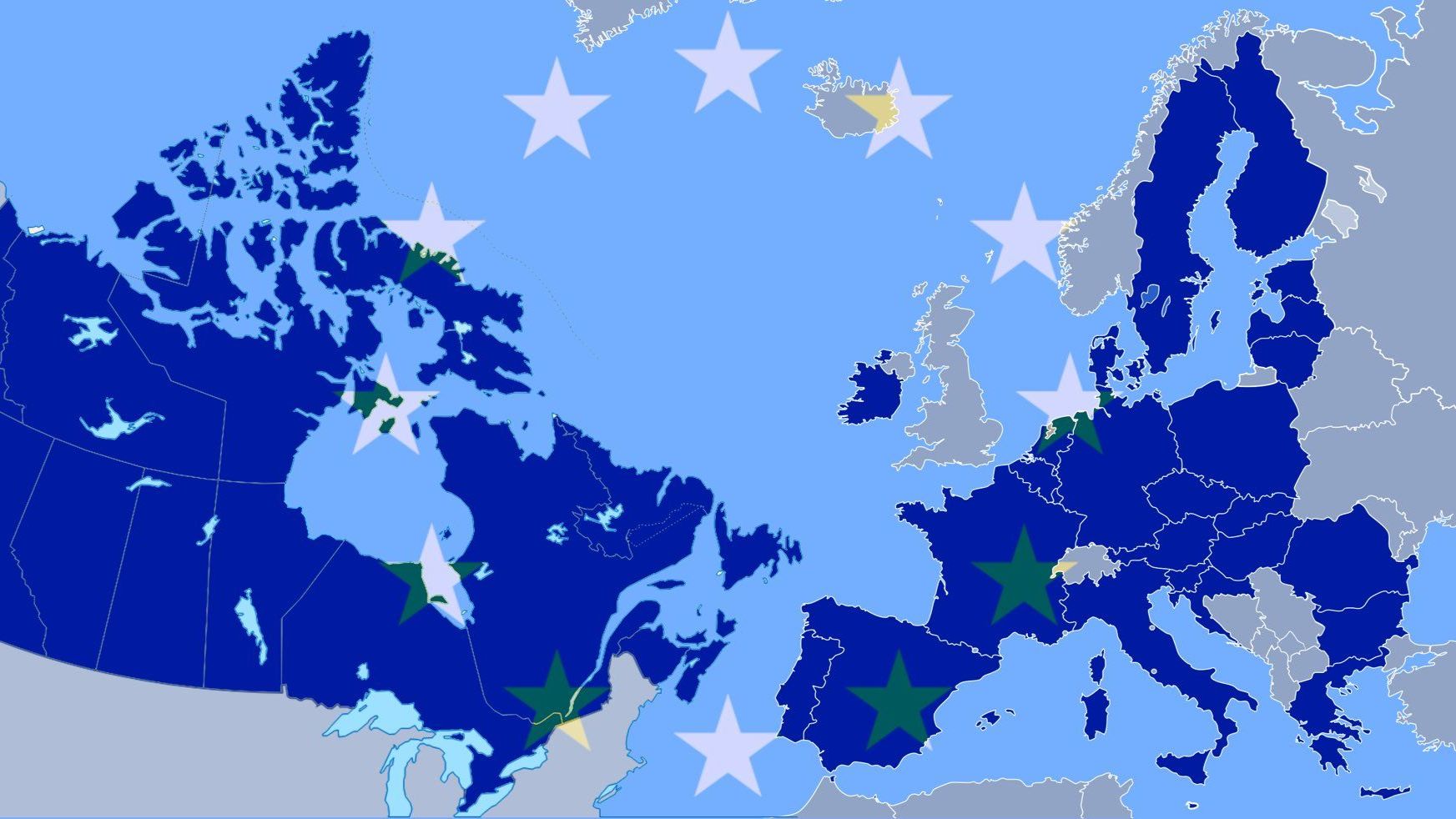
Canada and Europe are not bound by geography, even though our Danish friends know that we do share a 3,000 km border in the Arctic. We are bound by an affinity – elective, chosen, and renewed, and stronger for being so.
Today, our societies are being shaken by new storms: the upheaval caused by climate change, the erosion of democratic norms, the weaponisation of trade.
The multilateral institutions on which we relied have been weakened.
Sovereignty and openness are now difficult to reconcile. Economic integration is now being weaponised, and tariffs are being used as a means of pressure. Financial mechanisms are being used for coercive purposes. Supply chains have become vulnerabilities to exploit.
Technology is transforming the nature of warfare, the structure of economies, and the ability of states to govern.
Technology platforms increasingly seek to act as sovereign powers. They want to dictate the rules of regulation – and even circumvent them. They want to control our data, spread misinformation, and steal our children’s childhoods.
This combination is a ferocious storm. A single tree will come down in it. A forest will not.
That’s because beneath the forest floor, the roots of an oak intertwine with those of its neighbours, exchanging nutrients, adding strength to strength, creating a resilient, self-sustaining ecosystem.
Together, Canada and the European Union can anchor our ground to hold our values while forming a protective canopy under which our citizens can thrive.
This is about sovereignty. Our ability to live as we wish. It is about the freedoms we must fight for, every day.
Sovereignty requires resilience – the ability to withstand shocks.
Sovereignty goes beyond being able to feed, fuel, and defend ourselves. It now requires secure access to AI, semiconductors, critical minerals, payment systems, clean energy technologies, vaccines, and space-based communications.
I have recently posted on this blog a lot. As the blog’s manifesto explicitly mentioned the Middle East as a focus, the ongoing war of the United States/Israel with Iran, a country which I had visited nine times between 2003 and 2009, resulted in a new interest with the country and its people. My sentiments are torn. I have met different kind of Iranians, mostly friendly people. Despite that I definitely cannot live there for much longer than the 10 days or two weeks in 2008/2009 when I had been invited for giving a postgraduate course at the Islamic Azad University in Khorasgan.
Yesterday, I browsed through different posts I had written around Easter, when a botched “boots on the ground” operation took place south of Isfahan. I had listened to CBS 60 Minutes’ interview of an Air Force officer called Bravo whose F-15 fighter jet was shot down on 3 April. He was severely injured and miraculously rescued days later by his American fellow soldiers. When Bravo pronounced Iran consistently eye-‘ran (a telltale sign for real haters of the country and its people. In fact it must be ee-‘rahn), I stopped watching.
I remembered that I had reported, in subsequent posts on this blog, that the Wall Street Journalhad reported a screaming-for-hours Donald Trump who had to be be moved to another room when the rescue operation took place. I asked two times AI Gemini whether it could confirm my memories, to no avail.
Today, I made another attempt. This time I did it in German (the question is translated into English by GoogleTranslate and slightly edited).
Today, 25 years ago, 9-11 occurred. Then, all predicted the world would change forever. It did.
Eighteen years ago (in 2008), on another blog which is almost dead right now (as I am no longer extensively travel in the Middle East), I wrote:
“Where had I been 7 years ago? Well, I had been busy the whole day. It was 10 days before my intended significant translocation. In FOD, Kuwait, my new colleagues were waiting for me. I had read a book about the small country’s recent history with the title ‘A New Beginning,’ and I had got a feeling that this might even apply to my upcoming move. I had bought a copy of the Holy Qur’an as well and already tried to read in it.
I arrived at my flat at 7 pm, with cardboard boxes for shipping my personal effects later that week. When I had switched on my TV, I first thought that I was in the wrong movie. The Twin Towers in New York were burning? The news anchor’s voice had a shrill tone. America had been attacked by Islamic terrorists.
Well, I cannot exactly tell what I was thinking, but already half an hour later I got the first telephone call from a friend telling me that I will go to Kuwait and not change my mind! It would be safe whatever is going to happen in the next days.
When bidding farewell that week in September 2001, my friends were in fact disbelieving that I had not revised my decision. And nobody in Kuwait honestly expected me to come anymore. Later I heard from another expat who had lived many years in Riyadh that he and his wife left Saudi Arabia after 9-11 because of hostilities emerging against westerners and Americans, in particular. Fortunately, I’d never experienced any hostilities while living in the Middle East. Even three years later, when the US and allies toppled Saddam Hussein, I felt rather safe (despite a gas mask in my closet, which I had borrowed from my Embassy, and taped windows in my flat).
My immediate feeling that the later declared war on terrorism will inevitably change the world became reality in the meantime. I have left the Middle East last year for mainly professional reasons. But I became also more and more concerned about possible new military attacks in the near future, another war about oil and gas in the region. And this time Iran is going to be threatened. It doesn’t bear thinking about!”
A frequent commenter then, eshda3wa wrote: “its interesting how we (ppl of the mideast) sit at home drinking our tea while someone with two brain cells decide hmmm im going to bomb Iran for no apparent reason fighting a phantom … disrupting all our lives .. and we have no say in it”
Joud said: “i was in the east coast, watching it over and over again on tv, in disbelief i remember thinking – pls God dont let them be Arab dont let them be muslims
Another frequent commenter then, Intlexpatr said: “The only one talking about attacks on Iran is Ahminadjad (spelling not quite right, sorry). I never heard a word about Iran my entire summer in the US. The only place I see it in the papers is in Kuwait.
The average American doesn’t even know about the Israeli hits on Syria last year.
I can only guess that they are afraid nuclear facilities will be bombed by the Israelis, as they were in Syria. Other than that, I can’t imagine what he is worried about. If he does NOT have nuclear facilities, he has nothing to worry about.”
I responded: “intlxptr, eshda3wa: they have. I have even seen it in Natanz when visiting Iran as a tourist in 2005. But they claim that it is for peaceful purposes only. And A. uses unacceptable language when talking about Israel (which he doesn’t mention by name). According to President Bush, all options are still on the table. And Israel has done military air force exercises in the Mediterranean in June. And Sarkozy warned them (my interpretation) not to strike on their own when pledging at the Knesset, they are not alone. There is a lot more which concerns people in the Middle East and those who have friends in Iran. And I know also their fears.”
It took a long time before Iran was attacked by its arch enemies, the United States and Israel. Neither Bush Jr. nor Obama, let alone Biden, dared to attack Iran. Trump boasted of having done so. (After Benjamin Netanyahu had whispered into his left ear that he should do it.)
“Look, for 47 years, no president was willing to do what I’m doing, and they should have done it a long time ago. It would have been a lot easier. There’s no president that wanted to do it.”
“And yet every president knew. I’ve spoken to a certain president, who I like, actually, a past president, a former president. He said, ‘I wish I did it, I wish I did,’ but they didn’t do it. I’m doing it,” the President continued. It wasn’t Obama (Trump, by the way, doesn’t like him; maybe he spoke of late President Carter).
This is a personal weblog. The information in this weblog is provided "as is" with no warranties, and confers no rights. The opinions expressed here represent my own and not those of my employer.
I am not responsible for the content of external internet sites.
Privacy & Cookies: This site uses cookies. By continuing to use this website, you agree to their use.
To find out more, including how to control cookies, see here:
Cookie Policy


You must be logged in to post a comment.