Four years on, Iranians need to elect a new president. More than ever, the world is either watching or just ignoring the more than complicated proceedings. That controversial figures former president Akbar Hashemi Rafsanjani and Mahmoud Ahmadinejad’s favorite Esfandiar Rahim Mashaie were even allowed to announce their candidacy (on the last minute) comes only as a surprise for some. But why should Iran’s Supreme Leader Ayatollah Khamenei bar any of the almost 700 hopefuls at the moment? This would certainly arouse bad memories of Ahmadinejad’s re-election four years ago which was inevitable.
When Gary Sick speculates that Hashemi and/or Mashaei believe that “Khamenei (1) acquiesced in their candidacy; or (2) could not prevent it; or (3) was essentially irrelevant,” he just does not take into account wisdom of an elder statesman. If, as the Guardian Council, which vets the candidacies, announced yesterday may approve up to 40 presidential hopefuls, there is any opportunity to remove unwanted figures on Khamenei’s personal request.
That Mashaie would eventually be allowed to run is highly unlikely. He doesn’t belong to the Islamic Republic’s establishment. None of his nationalistic (rather than Islamistic) ideas including his infamous statement in public in 2008 that the American and Israeli peoples are friends of Iran are supported by either the clerics nor the Revolutionary Guards. They have openly been declared as “deviant”. His closeness to Ahmadinejad is downright a disadvantage.
I do not expect Rafsanjani to run either. Four years ago, another former president, Mohammad Khatami, withdrew briefly after he had announced his candidacy. I had written then that “Khatami might even have perceived signals that he certainly won’t receive the Supreme Leader Ayatollah Ali Khamenei’s support” which might be equivalent with blatant threats. Multi-billionaire (dollars, not toman) Rafsanjani, who had given a remarkable and certainly not forgotten Friday sermon on 17 July 2009 putting him close to the so-called Green Movement, as well as his family have to lose a lot, probably too much. Symbol of the corrupt system, he is not popular at all among the poor and even Iran’s struggling middle class in the large cities’ urban slums and the countryside who still represent Iran’s majority. He might be removed from the list by the Guardian Council just because of his age of 78 years.
Overall, it won’t matter. There won’t be a revolt on June 14 or afterwards. Khamenei’s man will win as expected, whether it will be Saeed Jalili (civilized, smart, presentable) or Tehran’s major Mohammad-Baqer Qalibaf, or somebody else.
While western mainstream media may celebrate the 65th anniversary of the State of Israel these days, this is usually also associated with al-Nakba, the catastrophe of the Palestinian people. Forceful expulsion and expropriation of hundreds of thousands of Palestinians then living in Mandatory Palestine. That al-Nakba might have begun one and half centuries earlier, when General Bonaparte with his 13.000 French soldiers attempted to advance into Ottoman Palestine in 1799 in order to check British expansion is not so well-known. In his recent book Napoleon’s Egypt: Invading the Middle East, Juan Cole only briefly touches the brutal Syrian campaign of 1799.
According to Al Jazeera’s critically acclaimed documentation of 2008, the later Napoleon then had encouraged the “Jews of the world to reclaim their land in league with France.”
“This story [the Nakba] starts in 1799, outside the walls of Acre in Ottoman-controlled Palestine, when an army under Napoleon Bonaparte besieged the city. It was all part of a campaign to defeat the Ottomans and establish a French presence in the region.
In search of allies, Napoleon issued a letter offering Palestine as a homeland to the Jews under French protection. He called on the Jews to ‘rise up’ against what he called their oppressors.
Napoleon’s appeal was widely publicised. But he was ultimately defeated. In Acre today, the only memory of him is a statue atop a hill overlooking the city.
Yet Napoleon’s project for a Jewish homeland in the region under a colonial protectorate did not die, 40 years later, the plan was revived but by the British.”
Whether this was Bonaparte’s real intention, is highly questionable, though. It seems to be one of the numerous myths about the origins of Zionism.
Great opportunity. Since I am in Germany, unintentionally and somewhat enervated, I might have a chance to visit once more one of the major Jazz festivals in the world. I was a regular concertgoer there in the late 1970s and most of the 1980s, but had somehow lost interest in New Jazz later.
Just before I moved to the Middle East in 2001 (a couple of weeks before September 11, which then changed the world), The Residents (something which I had in fact predicted in 1982), Fred Frith, and David Thomas performed on one evening, which was dedicated to “Art Rock” (not Jazz at all; pretty unforgettable) in one of the largest circus tents of the world in the rather unlikely city of Moers on the Lower Rhine, except for Pentecost just backwater.
Fred Frith who is among the most frequent artists at Moers will come again this year, as well as John Zorn who got the whole first evening together with his gang. See the full program here.
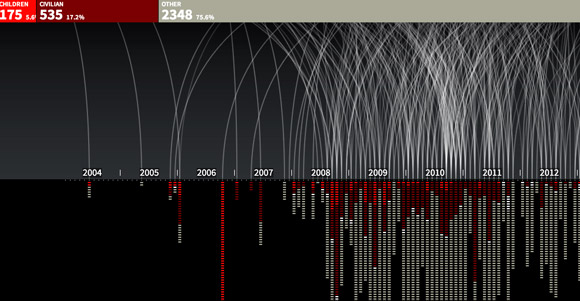
As Noam Chomsky has described earlier this year President Obama’s drone war on terror in Afghanistan, Pakistan, the Yemen and several other countries as just a “global assassination campaign”, designers at Pitch Interactive have now described every known attack by the US since 2004 in a stunning, well shocking, interactive graph and movie using data from the the Bureau of Investigative Journalism. Accordingly, a mere 1.5% of high profile targets were killed while 175 casualties were children and 535 civilians.
It’s ten years after G.W. Bush and his allies (UK, Australia and a “coalition of the willing”) attacked Iraq and quickly toppled Saddam Hussein’s regime. The war was illegal, weapons of mass destruction have never been found, at least 130,000 Iraqis have been killed, millions displaced. Torture in detention centers, abuse in Abu Ghuraib and elsewhere. The Iraq War Logs, leaked by Bradley Manning and published by WikiLeaks and major main stream media in 2010, must be regarded one of the most significant documents of our time, and its full analysis will take more years if not decades. Responsible figures such as Bush, Cheney, Rumsfeld, Blair and others are now retired, never indicted for any war crimes at least in their own countries, but elsewhere, sure.
These days, the so far 3rd war (not the second!) in the Gulf region marks its 5th anniversary. The operation was called Shock & Awe and I was watching the bombing of Baghdad live on my TV in a flat in Kuwait. Incredible, Baghdad and its avenues at the Tigris river were brightly illuminated when the first bombs blasted! It looked more like a Hollywood movie. How could that be broadcast to the World? While we were sitting here in a totally dark, blacked-out Kuwait!
I really can tell, I was shocked and awed. We had spent the last days before the outbreak of war with shopping of the special kind, hoarding meat, tuna fish and vegetables in cans, getting large amounts of rice and noodles, buying candles.
Our former Faculty Dean had briefed the brave of us, who were about to stay, in one of the then rare Faculty meetings: There might be curfews in Kuwait. The Americans troops will be in Baghdad within 72 hours. University will be closed for a week or so. Life will go on. But the women were free to leave Kuwait for some time, of course.
A couple of days earlier, a Scandinavian colleague had proudly presented his gas mask which the German Embassy had lent him. Scandinavians do not have their own Embassies in Kuwait. When making a telephone call to the Embassy, the most helpful Ms Lorenz there, who had served the quickly changing German Ambassadors for 30 years or so, calmed me down. But maybe taping of the windows would be a good idea.
I had arrived from a scientific meeting in San Antonio already on the 12th of March 2003. I had made my final decision of coming back to Kuwait only at the airport in Frankfurt, when I had met our Vice Dean and another chairman of our Faculty. The three of us had the same thoughts but didn’t tell: Okay, these guys are also going back to Middle East!
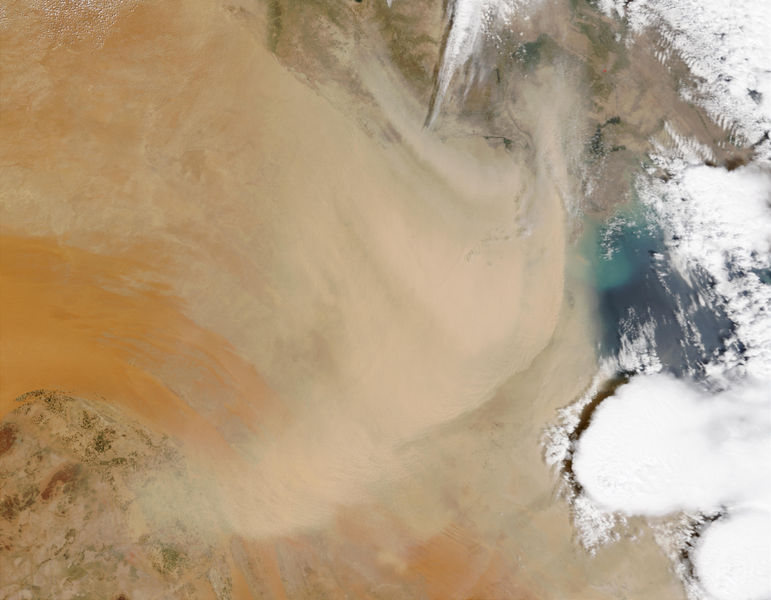
The flight from Frankfurt to Kuwait City was horrible, a nightmare. The airspace was already closed over Iraq. Instead of taking the direct route from the Balkans, Turkey, Iraq to Kuwait, we had to fly over Jeddah at the eastern coastline of the Red Sea, then cross the whole Arabian Peninsula and Rhub Al Khali, then towards Bahrain, and then back to Kuwait. The plane was shaken by an enormous sandstorm between the tiny island in the Gulf and Kuwait and I almost had to say my final prayers. It was the first in a series of nearly weekly sandstorms which hit Kuwait later until May.
In Kuwait, it turned out that I had lost my luggage, and I had it back only after several weeks. Lufthansa had stopped flying to the Middle East, no way to go there during the war operations. I was promised, it would be safer in Frankfurt.
For one week we were advised not to drive in Kuwait by car, to stay at home and listen to any alerts. There were 20 or so, and one missile hit in fact the sea close to the Sultan Center in Souq Sharq. No casualties, fortunately. No poison gas either. Were there any shelters? We were at least not informed. Indeed, University was closed only for a week or so, and then life went on. The numerous, weekly sandstorms were most probably caused by military operations in the North. Embedded journalists (with questionable professional ethics) reported from what seems to be a big adventure every day. People in Basrah did not welcome the British troops, but when Baghdad was taken, we saw pictures of delighted inhabitants waving and dancing in the streets. An ugly statue of Saddam in Firdos Square was toppled already in early April. But Bush’s declaration of the end of military action on May 1, 2003 on aircraft carrier USS Abraham Lincoln (“Mission accomplished”) turned out to be an illusion. Abu Ghuraib, only one year later, changed everything. The emerging civil war in Iraq led millions of people flee to neighboring countries, if they could. Some said that about 1 million civilians have died in the meantime, but figures may have been overestimated. The Iraqi body count may be found here.
In the meantime, the head of the U.S. Central Command, Admiral William “Fox” (another desert fox) Fallon, has resigned after having given the Esquire an interview (which will appear next month). There were heavy disputes, of course, with the Commander-in-Chief on Iraq and Iran policies, and even with his General Petraeus, who had reported (and is about to report again) on the successful ‘surge’, gated communities in Baghdad, and a general better life in Baghdad and Iraq. Right now, presidential candidate John McCain visits the site, and soon Vice President Dick Cheney will arrive for respective celebrations.
What to say five years after the U.S.-led invasion to end years of dictatorship? We wish the Iraqi people a better future, honestly. And, the last the world could afford is another military conflict in the region.
This is a personal weblog. The information in this weblog is provided "as is" with no warranties, and confers no rights. The opinions expressed here represent my own and not those of my employer.
I am not responsible for the content of external internet sites.

 Freelance
You must be logged in to post a comment.