Twenty-seven

Apart from now common and frequent reference to Iran being in contrary to UN Security Council resolutions, the latest Iran report of UN nuclear watchdog Yukiya Amano does not state anything new except that environmental samples taken at the Fordow uranium enrichment site have revealed a level of enriched uranium above what has Iran has declared to the International Atomic Energy Agency (IAEA), 27%.

“28. The results of analysis of environmental samples taken at FFEP (Fordow Fuel Enrichment Plant on 15 February 2012 showed presence of particles with enrichment levels of up to 27% U-235, which are higher than the level stated in the DIQ (Design Information Questionnaire). In a letter dated 4 May 2012, the Agency (IAEA) requested that Iran provide an explanation for the presence of these particles. In its reply, dated 9 May 2012, Iran indicated that the production of such particles “above the target value” may happen for technical reasons beyond the operator’s control. The Agency is assessing Iran’s explanation and has requested further details. On 5 May 2012, the Agency took further environmental samples from the same location where the particles in question had been found. These samples are currently being analysed.”

David Albright, president of the Washington-based Institute for Science and International Security (ISIS), has an explanation and both dampens and fuels the immediate brouhaha in mainstream media.

“The IAEA has found traces of uranium enriched up to 27 percent at Iran’s Fordow enrichment plant. This elevation is likely due to improved cascade design. An effect is to overshoot 20 percent when 3.5 percent LEU (low enriched uranium) is fed into the tandem cascades at the old feed rate for 15 stage cascades. To avoid this problem, Iran likely increased the feed rate of 3.5 percent LEU, which lowered the enrichment level of the product back to 19.75 percent. It also increased slightly the amount of 19.75 percent produced.

This development is an embarrassment for Iran but it is not a sign of Iran moving to higher enrichment levels. Nonetheless, its deployment of a 17-stage cascade reflects a reconfiguration of the cascades that can make breakout faster and more efficient.” (Emphasis added.)

Well, 19.75% is a construct anyway. It is conventionally LEU while 20+ percent would be highly enriched uranium (which automatically would lead to brouhaha).  That the Iranians are embarrassed is rather not likely. That IAEA inspectors were able to detect these “particles” indicates just two things: That Iran can quickly enrich to higher levels if a respective decision was made and that the IAEA can easily monitor this (provided Iran has made them aware of each of its enrichment facilities; Amano again complains that Iran has specified, in 2010, the locations of ten further sites without providing the IAEA with respective information yet).

Last modified May 26, 2012.
Posted in IAEA, Iran | Tagged , , , , , , | Leave a comment

After Baghdad – What Next?

That the two-day meeting of E3+3 with an Iranian delegation in Baghdad over the latter’s nuclear program has de facto been adjourned to be continued in Moscow on June 18 is probably the only outcome which may prevent the whole endeavor of being a complete failure. Sanctions were not to be removed off the table (or even softened), but why should Iran then give in stopping further enriching uranium?

In an uncommon move the International Atomic Energy Agency’s (IAEA) Director General Yukiya Amano was sent had arrived just hours before the Baghdad meeting in Tehran to negotiate a deal which would IAEA inspectors grant an easier access to suspicious facilities, most probably including that at Parchin which had been identified of having been the place of experiments with high-explosives a decade ago. Iran had signaled cooperation and willingness to sign a respective agreement (just an additional protocol to the Nuclear Non-proliferation Treaty, Iran is a signatory of since 1968). What else could be expected? Iran had done so already in 2003 (but never ratified it by its parliament) and only abandoned it in 2006 when facing several rounds of UNSC sanctions.

The upcoming report by Amano might shed light on what has actually been agreed upon and when Parchin and the respective building allegedly containing the high-explosive test chamber, which might have been cleansed in the meantime, can be visited. What IAEA inspectors are so keen to see there is, after all, unclear. ArmsControlWonk’s Jeffrey Lewis had yesterday debunked the hype in the West about the building which might have been the site of, illicit or not, experiments in the early 2000s. High-explosive test chambers just look different than the ominous computer-generated drawing which has been circulating for some time now and which only reminds us of similar disingenuous attempts by W. G. Bush’s Secretary of State Colin Powell when he tried to convince the public about the immediate threat of Saddam’s weapons of mass destruction nine years ago.

The likelihood that a highly desired agreement between the IAEA and Iran is actually signed within the next coming days is, after next-to-nothing results of the Baghdad meeting, pretty small.

Last modified May 25, 2012.

Posted in Iran, NPT, P5+1 | Tagged , , , , , , | Leave a comment

Parchin Spring Cleaning

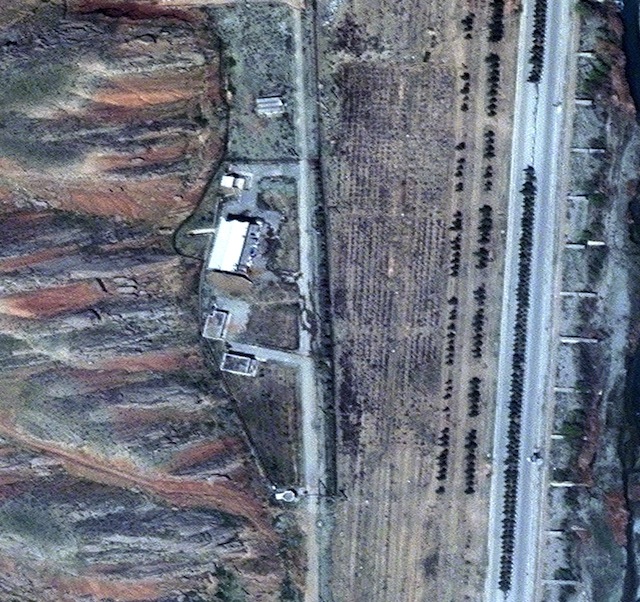
When I first saw the latest satellite image of April 9 of a suspect building at the Parching military complex where 10 years ago Iran might have conducted illicit experiments using a high-explosive  test chamber as reported in the November 2011 safeguards report of the International Atomic Energy Agency (IAEA), I instantly had to think of spring cleaning. So did Spencer Ackerman at Wired. Lots of water is apparently running and it appears that several small items have been moved outside the building. David Albright and Paul Brannan of the Washington based Institute for Science and International Security (ISIS) show, in comparison, images taken on 4 March 2012 and 28 July 2011, apparently lacking any activity. IAEA delegated had been denied access to the complex twice this year, in January and February. IAEA Director General Yukiya Amano had already expressed concern that the IAEA has “information that some activity is ongoing there [at Parchin].”

It would have been helpful if Albright and Brannan had provided, in comparison, images of other buildings of the huge complex showing lack of similar cleansing rather than images of March (before the Iranian New Year festival of Nowruz) or July (summer).

Publication of the new satellite image at Parchin was in coincidence with the suspicious death of an IAEA inspector two days ago in a car accident near Arak when on a mission to visit Iran’s nuclear complex at Khondab in the Markazi province. There have already been unsubstantiated speculations about “some form of retribution” in sort of response to recent killings of nuclear scientists in Iran by Jeffrey Lewis at ArmsControlWonk.

Last modified May 11, 2012.

Posted in IAEA, Iran, NPT | Tagged , , , , , , , , | Leave a comment

Peoples of the Middle East

Middle-East-Cultural-Historical-Regions-Map

Regions in the Middle East. I am pretty sure that most who are interested in this part of the world do not know much about them. What about the peoples? Columbia University’s Gulf 2000 project  and its cartographer Dr. Michael Izadi have generated highly informative maps on ethnities, languages, tribes, faiths, etc. Thanks to Gary Sick who has featured them today on his blog,  I enjoyed browsing through a trove of new and fascinating information of an extremely important part of the world still largely unknown, though.

Last modified May 2, 2012.

Posted in Middle East | Tagged , , , , , , , , | Leave a comment

Maybe a Breakthrough

Talks in Istanbul today between delegates of the the UN Security Council member states plus Germany, and Iran over the latter’s disputed nuclear program are said to have been constructive. After weeks of mixed and highly confusing messages sent out by President Obama and his administration about either acceptance of Iran’s enrichment program in the event Iran’s Supreme Leader Ayatollah Ali Khamenei would once again confirm that the country doesn’t seek nuclear weapons and unrealistic demands of closing down and dismantle the enrichment facility in Fordow and surrender any enriched uranium, be it at 3.5 or 20%, eventually the parties are now sitting at the same table.

Is this, as Obama claims, Iran’s last chance to solve the problem by diplomacy? Certainly not. We should recall the rather dexterous Iranian conduct of negotiations on 1 October 2009 in Geneva when chief nuclear negotiator Saeed Jalili got quasi a green light from President Ahmadinejad for a swap deal which would mean that Iran would have sent out most of its lowly enriched uranium and receive in return fuel plates for its research reactor in Tehran (TRR). We all know that the deal did not receive formal approval by the Supreme Leader due to resistance of Ahmadinejad’s strong adversaries speaker of the parliament Ali Larijani and, well, Mir-Hossein Mousavi, the leader of the Green Movement. And in 2010, another attempt, outlined in the Iran-Turkey-Brazil deal called Tehran Declaration, failed (“too little, too late”) when Obama and Secretary of State Hillary Clinton were more in favor of pushing for another round of sanctions.

Both sides urgently need success. Obama cannot afford an Israeli attack in his reelection year and neither can Iran. Thus, one might realistically expect that both sides seek a win-win outcome with reasonable compromises. To provide Iran with fuel plates for the TRR, to accept its enrichment to 3.5% on one side; to stop enriching to 20% and allow inspectors of the International Atomic Energy Agency better access to all nuclear facilities (i.e., eventually ratifying the Additional Protocol of the Non-proliferation Treaty and the modified code 3.1) on the other. Then sanction have to be lifted.

Last modified April 14, 2012.

Posted in IAEA, Iran, NPT, P5+1, USA | Tagged , , , , , , , , , , | Leave a comment