A Test for All of Us

When Glenn Greenwald’s partner David Miranda was detained yesterday for nine hours at Heathrow airport “under schedule 7 of the Terrorism Act 2000 (sic)”  and all electronic devices including laptop, USB sticks, memory cards, DVDs and mobile phone seized, I instantly thought that it might have been a test arranged by Greenwald about whether he ever could leave Brazil where the couple is residing. So, probably not, no more. Miranda had reportedly met with Laura Poitras in Berlin, Germany, Poitras is the filmmaker who was first contacted by Edward Snowden in January and who, together with Guardian journalist Greenwald flew in June to Hong Kong to interview him.

Greenwald is smart and Miranda was probably well-advised not to carry along any material related to Snowden when returning to Brazil. This is a test for all of us – with a revealing result so far. Claims by the U.S. administration that they knew about Scotland Yard’s plans to detain Miranda but were not involved are hardly credible. As Juan Cole writes slightly exaggerating, and Jimmy Carter has recently warned in a speech behind closed doors at Die Atlantikbrücke, the United States struggles with its democratic values. A first step in getting it on the right track again is exposing its wrongdoings whenever they occur or become available. That’s what whistle-blowers have done in the past couple of decades.

The test is not over. Coverage, even by mainstream media, of illicit total surveillance attempts, the Bradley Manning case and Wikileaks is widespread and seems to be lasting. This is because journalism itself is in limbo, America’s First Amendment.

20 August 2013 @ 6:25 am.

Last modified August 20, 2013.

Posted in surveillance, UK, USA | Tagged , , , , , | Leave a comment

Master John and Brother James

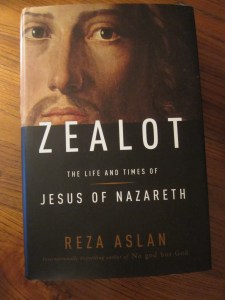
IMG_0088

I have to admit that, after the media hype about Reza Aslan’s Jesus biography (in particular after he was interviewed by Fox News’ Lauren Green), only then I became curious of Zealot – The life and times of Jesus of Nazareth [1].

That the author Reza Aslan was a devout Muslim Iranian mattered, too. I have critically written about Tilman Nagel’s opus maximum of a biography of the prophet Muhammad before [2]. Nagel, an eminent scholar of orientalism, did not get the point. As I wrote then,

“Nagel’s profound knowledge and the numerous original sources which have not been used so far do not prevent him from drawing an utterly negative picture of the Prophet of Islam. One might in fact get the impression that Nagel wants to make Muhammad basically responsible for cruelties, assassinations, even massacres, and abuses of the very time when he was living. His life, so Nagel, was dominated by power intrigues, sexual obsession. As everybody knows, Muslims hold Muhammad as fallible human being […]. Nagel talks consistently about his “alter ego” when he refers to revelations of Allah which later have been included into the holy Qur’an. It is unfortunately nothing else than defamation of Islam as Mohammedanism.”

Reza Aslan does describe the indeed tumultuous times of Jesus correctly and gives a rather detailed account of Judea, which he throughout identifies as Palestine [3], a marginal province of the Roman Empire. There have been three large-scale Jewish rebellions against Roman occupation in the 1st and 2nd centuries (between 66 and 125 CE), just when most of the gospels and epistles of the New Testament were written. In fact, one must assume that they were written in response to the revolts. As Aslan explains, Jesus of Nazareth, an illiterate peasant or carpenter, and social revolutionary [4], who more or less lacks any historicity, has in fact been transformed into Jesus Christ the Redeemer in these troublesome times by his inspired contemporaries. The more memories faded, the more he was seen as God incarnate which became dogma soon after the Nicaean council in 325 CE.

The book’s seriousness heavily relies on its end notes on 53 pages, not 100 as Aslan claims in the infamous Green interview, and his bibliography of 200 references or so, which cites the major works by other authors. Many of his provocative or thought provoking theses in the main text, which sometimes comes as an inspired narrative, would appear speculation. In a way, it was a smart decision by the author or publisher who needed sort of provocation to once again address a broader audience. After all, there is not so much new in Aslan’s book. Even his firm stance on Jesus having been a disciple of John the Baptist has been discussed by some authors before. Interesting is, how he explained the more or less disappearance of one of the pillars (besides Peter and John the Apostle) of the new faith, James the Just, in favor of Saint Paul. Aslan quotes Robert L. Webb (Jesus’ baptism: its historicity and implications. Bull Biblical Res 200; 10.2: 261-309) at length on page 245 of his book.

“Jesus was baptized by John and probably remained with him for some time in the role of a disciple. Later, in alignment and participation with John and his movement, Jesus also engaged in a baptizing ministry near John. Although he was still a disciple of John, Jesus perhaps should be viewed at this point as John’s right-hand man or protégé. While tensions may have arisen between John’s disciples and those around Jesus, the two men viewed themselves as working together. Only later, after the arrest of John, did a shift take place in which Jesus moved beyond the conceptual framework of John’s movement in certain respects. Yet Jesus always appears appreciative of the foundation that John’s framework initially provided for him.”

That it was the “Apostle” Paul, and not James, who created the new creed by proselitizing gentiles in an early phase of the movement is trivial. James, the “bishop of bishops” residing in Jerusalem, has more or less been forgotten. There might have been tensions between James, John and Peter on one side and savvy Paul on the other. What counts is that his mission was a triumph. He might be compared only to Muhammad a couple of centuries later.

Notes

[1] Aslan R. Zealot – The life and times of Jesus of Nazareth. Random House, Inc. New York 2013.

[2] Nagel T. Mohammed – Leben und Legende. Oldenbourg, Munich 2008.

[3] Since this is historically incorrect, it might be a revealing detail of the author’s real agenda. Syria-Palaestina was the name, the Roman Emperor gave the province in 132 CE, just before the revolt led by Simon Bar Kokhba.

[4] The title of he book, “Zealot”, suggests that Jesus belonged to 1st century Zealotry political movement which tried to incite Judeans to rebel against Roman occupation and expel the Romans from the Holy Land. “Zealous” in enforcing God’s law and blazing the trail for God’s revenge. This is certainly misleading. Jesus’ teachings had nothing to do with rebellion against the Romans. Jesus rather addressed Jews to endure their enemies, not to fight them. Some evidence for this view: In his sermon on the mount (which illustrates his revolutionary ethics best),  Jesus recommends, “[w]hen someone strikes you on (your) right cheek, turn the other one to him as well.”  How strikes someone right handed on another person on the right cheek? It must be the humiliating manner of a member of the occupying power who slaps with his back of his right hand rather than strikes. Then, “[i]f  anyone wants to go to law with you over your tunic, hand him your cloak as well. Should anyone press you into service for one mile, go with him for two miles.” (Matthew 5: 39-41.) Who wants to have one’s tunic? Who wants to press someone into service for a mile? Definitely not your Jewish neighbor. Aslan may be quite wrong when suggesting that “enemy” meant “your neighbor enemy”. Among Jesus’ disciples is one Simon the Zealot, though (Luke 6: 15).

16 August 2013 @ 10: 40 am.

Last modified August 17, 2013.

Posted in Academics, Book Review | Tagged , , , , , | Leave a comment

Obama’s Speech in Cairo in 2009 and His Lack of Honesty in 2013

Obama had delivered one of his great speeches in Cairo in June 2009. Apart from the diplomatic cables leaked by Bradley Manning later that year to WikiLeaks which demonstrated, among other things, shameless political corruption and how the United States supported and stabilized dictatorships in MENA, even Obama’s nice words (they ultimately earned him the Nobel Peace Prize) may have let to a revolutionary situation when he said, for instance,

“The United States has been one of the greatest sources of progress that the world has ever known.  We were born out of revolution against an empire.  We were founded upon the ideal that all are created equal, and we have shed blood and struggled for centuries to give meaning to those words — within our borders, and around the world.

“I know — I know there has been controversy about the promotion of democracy in recent years, and much of this controversy is connected to the war in Iraq.  So let me be clear: No system of government can or should be imposed by one nation by any other.

That does not lessen my commitment, however, to governments that reflect the will of the people.  Each nation gives life to this principle in its own way, grounded in the traditions of its own people.  America does not presume to know what is best for everyone, just as we would not presume to pick the outcome of a peaceful election.  But I do have an unyielding belief that all people yearn for certain things:  the ability to speak your mind and have a say in how you are governed; confidence in the rule of law and the equal administration of justice; government that is transparent and doesn’t steal from the people; the freedom to live as you choose.  These are not just American ideas; they are human rights.  And that is why we will support them everywhere.

Now, there is no straight line to realize this promise.  But this much is clear:  Governments that protect these rights are ultimately more stable, successful and secure.  Suppressing ideas never succeeds in making them go away.  America respects the right of all peaceful and law-abiding voices to be heard around the world, even if we disagree with them.  And we will welcome all elected, peaceful governments — provided they govern with respect for all their people.”

He even addressed then long-time dictator Hosni Mubarak,

“This last point is important because there are some who advocate for democracy only when they’re out of power; once in power, they are ruthless in suppressing the rights of others.  (Applause.)  So no matter where it takes hold, government of the people and by the people sets a single standard for all who would hold power:  You must maintain your power through consent, not coercion; you must respect the rights of minorities, and participate with a spirit of tolerance and compromise; you must place the interests of your people and the legitimate workings of the political process above your party.  Without these ingredients, elections alone do not make true democracy.”

Immediately after that sentence, one could hear an excited voice, “Obama, we love you!”

Obama today is much more cautious in what he says, but what he doesn’t say is deafening. He had never sympathized with WikiLeaks and any of the Arab Revolutions, be it in Tunesia, Egypt, Yemen or uprising in Bahrain or eastern provinces in Saudi Arabia. That Egypt has held meanwhile several elections, it’s just a nuisance. When the elected Egyptian president Mohamed Morsi was ousted by a military coup, his Secretary of State John Kerry called it “restoring democracy”. Meanwhile the junta has shown its real face. Hundreds have been killed in a massacre yesterday. But Obama seems to be just dismayed. A shameless “[l]et me say that the Egyptian people deserve better than what we’ve seen over the past several days,” but no word about cancelling the grotesque sum of $ 1.3 billion of military aid per year. He just cancelled a scheduled joint military exercise.

15 August 2013 @ 6:09 pm.

Last modified August 15, 2013.

Posted in Uncategorized | Tagged , , , , | 1 Comment

Bradley Manning Apologizes

Pfc Bradley Manning, who is struggling right now for having the number of years he is going to spend behind bars reduced (from a shocking 90) has yesterday apologized for hurting “people” and “the United States” when leaking hundreds of thousands of mostly secret documents to WikiLeaks. Sure, as a soldier, he has broken his Oath of Enlistment,

“I, _____, do solemnly swear (or affirm) that I will support and defend the Constitution of the United States against all enemies, foreign and domestic; that I will bear true faith and allegiance to the same; and that I will obey the orders of the President of the United States and the orders of the officers appointed over me, according to regulations and the Uniform Code of Military Justice. So help me God.” (Title 10, US Code; Act of 5 May 1960 replacing the wording first adopted in 1789, with amendment effective 5 October 1962),”

but what about enemies within? According to Associated Press, “[h]e said he realizes now that he should have worked more aggressively’ inside the system’ to draw attention to his concerns about the way the war was being waged.” As far as we know, he tried to draw attention, but failed time and again. Take, for instance, the most famous Collateral Murder incident of an Apache helicopter attack in Baghdad on 12 July 2007 in which a dozen of civilians were killed including two Reuters employees. Reuters had called for an investigation of the incident and tried hard to get the video. While the video and, in particular, audio recording speak for themselves, the army investigation report on the two Reuters journalists can be seen here [pdf]. Manning has reportedly tried to draw attention from “inside the system”, but in vain. When he wanted to discuss the video with his superior, she claimed, according to his own testimony, that it wasn’t authentic.

His acts were based on Kant’s Categorical Imperative. In breaking his oath, as a soldier, he has rendered all of us invaluable service.

See a transcript of Manning’s remarks here [pdf].

15 August 2013 @ 7:38 am.

Last modified August 16, 2013.

Posted in USA | Tagged , | Leave a comment

Scope and Scale of NSA Surveillance

Transparency (of total surveillance by the NSA) was one of the magic terms in President Obama’s press conference at the White House yesterday. Simultaneously, the NSA published a 7-page statement [pdf] on its web page outlining what it is doing and on what basis. On page 6, the whole issue of total surveillance is down calculated for the common American subject who might in fact be more interested in sports than politics. In a box (for those who mind to go through the whole paper), at least one calculation error occurs.

In an attempt to compare total surveillance with a dime in a basketball court, the NSA writes,

Scope and Scale of NSA Collection

According to figures published by a major tech provider, the Internet carries 1,826 Pentabytes of information per day. In its foreign intelligence mission, NSA touches about 1.6% of that. However, of the 1.6% of the data, only 0.025% is actually selected for review. The net effect is that NSA analysts look at 0.00004% of the world’s traffic in conducting their mission – that’s less than one part in a million. Put another way, if a standard basketball court represented by an area smaller than a dime on that basketball court.

Well, 0.025% of 1.6% is 4 x 10⁻⁶. 0.00004% is another expression of 4 x 10⁻⁷. A basketball court has an area of usually 28 times 15 m2, or 4.2 x 106 cm2. A dime has a radius of about 0.9 cm. Thus, its area is about 2.54 cm2.  It would therefore represent about 6 x 10⁻⁷  or 0.00006% of the court. So, the NSA “touches” less than ten coins (or, in fact, six or seven) rather than one dime on a basketball court, on a daily basis.

If one believes the other figures.

10 August 2013 @ 3:32 pm.

Last modified August 10, 2013.

Posted in surveillance, USA | Tagged , , | Leave a comment