
I have recently posted my review of Hooman Majd’s new book, Minister Without Portfolio, here on my blog.
I had read the book with rather mixed feelings. On the one hand there was some admiration for a person with a successful career in the music industry and as journalist, author and writer, living involuntarily in exile (in the United States and the United Kingdom) and who had hardly ever spent any significant amount of time in his actual home country. On the other, a certain relief that it clearly showed the impossibility of actually getting along with this special case of an Islamic Democracy when socialized in the West.
No, Iran has become an impossible place to live in, at least after the stolen election in 2009, the year when I myself visited it the last time, months before the election.
In January, when I actually read Minister Without Portfolio, again, hundreds of thousands of Iranians took to the streets of Tehran and other big cities. This time, on 8th and 9th of January, the internet was closed down when probably tens of thousands (maybe 30,000 or even more) were killed by thugs of the regime, or executed.
There were hardly any reporters from the West in the country. The massacres took place without any witnesses. I have heard an Iranian exile this morning in a talkshow on TV stressing the point that such a massacre on just two days can only be compared with that in the Ukraine in September 1941 in Babyn Yar in the Ukraine. A horrendous misrepresentation.
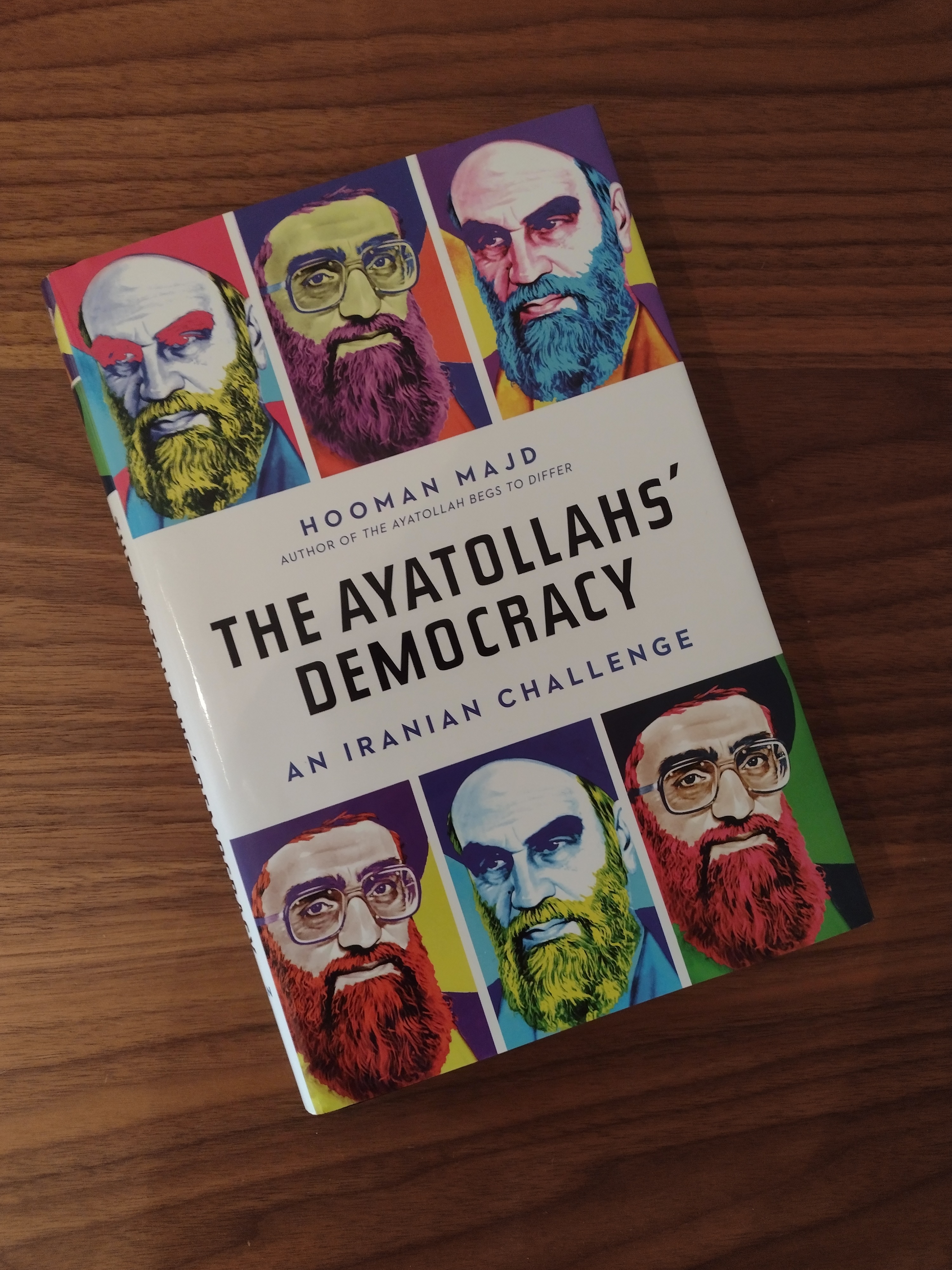
All this brought back memories of 2009. Majd had published the following year (2010) his account of what had happened then, The Ayatollahs’ Democracy. I have written about it here.
The Iranian Green Movement in 2009 was, according to Majd, not about Islam. It was about the Islamic version of Democracy. Their proponents, former Prime Minister Mir-Hossein Mousavi and Mehdi Karroubi, were reformists, closely related to the regime. Their spiritual leader, Marja (or Grand Ayatollah) Hossein-Ali Montazeri, first supported the Ayatollah (Khomenei)’s Democracy before breaking with the latter during mass executions of political prisoners after the Iraq-Iran war in 1988.
What happened after Ahmadinejad’s discredited, alleged landslide, victory in 2009 was not a revolution, or color or velvet revolution orchestrated by a hostile West. It was a mass movement of reformists. People took to the streets in disbelief and disappointment.
Majd describes the Iranian Democracy in detail, calls the various councils and assemblies Orwellian. The Supreme Leader, who has the final say in just everything.
The Guardian Council, a 12-member body serving a 6-year term. It may veto unconstitutional legislation, supervise election and approve or disqualify candidates in any elections, local or nation-wide. Six clerics are directly appointed by the Supreme Leader, six further by Iran’s Chief of Justice.
The Assembly of Experts, consisting of 88 clerics, vetted by the Guardian Council but elected by the public to serve 8-year terms. It monitors the performance of the Supreme Leader, may even impeach and remove him (all in theory), and select a new one.
And the little understood, even in Iran, Expediency Council Discernment Council. Officially charged with resolving differences and conflicts between the Guardian Council and the Parliament. It has been given greater power as it advises the Supreme Leader and was given authority over all branches of governmen after the election of Ahmadinejad in 2005. It’s 48 members are chosen by the Supreme Leader every five years.
Then there is the Islamic Consultative Assembly (Majles; the name itself indicates its limited law-making power) and, of course, the Islamic Revolutionary Guard Corps (Sepah-e Pasdaran).
Thus, the Ayatollahs’ Democracy is Islamic, opaque, in a way covered by multiple veils. It developed after Ruhollah Khomenei’s return from his exile in Paris in 1979 when he declared his vision. The Velâyat-e Faqih, the Guardianship of the Islamic Jurist. At least as long as the Imam Zaman, the 12th rightful successor of the Prophet, the Mahdi, stays in occultation.
So, it’s not a democracy at all.
But wait, Majd’s account, which I had blemished, after it had been released in 2010, as utterly apologetic, actually describing Democracy, the Ayatollahs’ way, reads, 16 years later, differently. There was a “democratic” mowj, or wave, in 2009, when Mir-Hossein Mousavi’s campaign gained momentum and masses of not only young people felt, what Barack Obama, in his first campaign in 2008, represented: Hope, Change, Yes We Can!
The many talks between Majd and, for example, former President Khatami (distantly related to Majd by marriage of his cousin to Khatami’s brother), or the leader of Friday prayers in the desert city of Yazd, or just ordinary people, before and in the four the weeks of the campaign leading to the disputed election in 2009 paint an utterly normal people’s vast interest in the election’s outcome.
Haven’t elections in Iran in 1996, 2001 (Mohammad Khatami’s first and second landslide victories) and 2005 (Ahmadinejad’s first) not led to fundamental changes to the better (only at first glance, in Ahmadinejad’s case)?
…
What is fundamentally different in Iran in January 2026 is the fact that the country and its regime has long developed into an Islamic Kleptocracy in full swing. Iran was highly corrupt even in 2009, when I visited the country for the last time, months before the election. But so was the entire Middle East. (Note that, in the latest edition of Transparency International, the Corruption Perception Score in the United Arab Emirates has slightly increased, among 186 countries they occupy rank 21, 8 ranks higher than that of the United States.)
Kleptocracies proliferate, in particular in established and emerging autocracies, see Russia under Vladimir Putin, the US under Donald Trump. But most are not in daily news, e.g. all former Soviet Union Republics, or new autocratic regimes in South America.
In Iran, the severe sanctions have mainly hit the general population, meanwhile even eradicated the middle class. High ranks in the IRGC and among the clergy (the “mullahs”; the pejorative term used in the West, cf. Mullah regime) have laundered and moved aside incredible amounts of money to the Emirates, Europe, and offshore tax havens; including investments in cryptocurrency and foreign property. In brazen violation of Islamic and, in particular, Shi’ite doctrine. Irans economy is in ruins, its ecology destroyed. Iran’s water management system is not only in a precarious condition. It may no longer exist. In a country which invented, thousands of years ago, qanāts!
Presently, Iran is even a black box. Nobody seems to know who is in charge. It is not clear whether the new Supreme Leader, Mojtaba Khamenei, is still alive, in coma, capable of leading the country…
The battle for democracy which took place in 2009 and which was described by Majd in his book was not about the Western ideal of democracy with rule of law, separation of powers, democratic institutions, a free press. It was about a rigged election. It was not an engineered, by Western forces, color (or velvet) revolution. It was about reforms.
Even a figure like Mahmoud Ahmadinejad, vilified in the West but, as Majd describes, rather a typical representative of his country, may not have implausibly been rightly elected in the 2005.
“To outsiders – even to many Iranians – President Ahmadinejad and his clique may appear to be representative of Iranians in general, a fringe element, particularly since his questionable re-election. But there have always been millions of Ahmadinejad’s in Iran, certainly in modern times: Iranians from sometimes humble backgrounds and from disparate towns and villages who have fought for equal access to power and to have their voices heard in its corridors, which until the twentieth century were restricted to a handful of elite families in the capital. (The last Shah’s father himself came from a humble background, from a village in the north near the Caspian, and had he been successful in ridding Iran of an ineffectual dynasty, in a later age he might have chosen republicanism instead of coronation as his due.) There are differing ideologies among these Iranians, to be sure, as are there differences in social attitudes, but they have in common a particularly Shia resistance to despotism and a fierce determination to ensure that Iran never again becomes the weak and exploitable state it became after the empire. Ahmadinejad and his closest cohorts, perhaps inclined less to democratic principles than they often claim, also know that it was nominal Iranian democracy, one that not only proclaimed independence from any greater power’s influence but also gave the people a voice, that first allowed them access to the presidential office in 2005. Iran is theirs too, and they will, like their overwhelmingly deeply religious supporters, who still number in the millions, have a say in the future of the Islamic republic they call Iran.”
Nominal democracy. Iranian.
During the two-and-half thousand years of Iran’s glorious and not so glorious history, there were two short periods when democratic institutions arose and consolidated: the Constitutional Revolution of Iran (1905-1911), and the time after WWII. During Prime Minister Mohammad Mossadeq’s attempt to nationalize Iran’s oil industry, the UK and US orchestrated a coup d’etat which forced Mossadeq from office in 1953.
The uprising in January 2026 was different from demonstrations in 2009. Seventeen years after the disputed re-election of Mahmoud Ahmadinejad, economy and ecology have reached unprecedented lows. (Remember, the administration had considered to move the entire city of Tehran, home to 14 million people, to the south as consequence of a deepening ecological crisis and water shortage, just weeks before people took to the streets.)
This time, even the bazaaris participated in the demonstrations which were primarily driven by a catastrophic economic collapse, deep frustration with government mismanagement, and a direct desire for regime change.
…
When I write these lines, it is the 27th day of the unprovoked war launched on February 28 by Donald Trump’s United States of America and Benjamin Netanyahu’s Israel. It is a war of choice, a war of aggression, in violation of international law. The first day saw already a decapitation strike killing a large number of Iran’s leadership including its second Supreme Leader, Ayatollah Ali Khamenei, and his wife.
Iran appointed Khamenei’s second eldest son, Mojtaba, as new Supreme Leader, who was present during the attack and probably seriously wounded. Whether he is still alive is not clear. Mojtaba is mentioned in Majd’s account of 2009 as a shadowy individual even then. Already at that time he was considered a possible successor of his father as Supreme Leader.
More leading figures known for a long time, and mentioned in Majd’s book, were killed in later strikes. (It seems that Israel possesses intelligence about the whereabouts of leading figures of the regime, so most of these strikes were done by Israel, in addition to strikes on sensitive infrastructure, facilities of Iran’s main gas field etc., while the US targeted presumed launch pads for missiles and drones, IRGC compounds as well as nuclear facilities.)
What about the religious and ethnic minorities in Iran? At the moment, news from inside Iran is sparse, if non- existent. A nationwide, near-total, internet blackout has been in place since the beginning of the war, generally cutting off international access. The intensity of the war has heightened the potential for severe internal repression. I am afraid that the regime tries to identify dissidents in the country as it seems that Mossad is still present. Christian and Jewish minorities in Iran are certainly under general suspicion.
Meanwhile Trump mocks his Iranian counterparts in negotiations about the details of their complete capitulation. “They are afraid of being killed, either by their Iranian fellows or by us!” Tactics of provocation of a US president who is very much used to never saying the truth.
True, they never had a navy, despite Trump’s claim that he has destroyed theirs. Majd in 2010, dedicating a short paragraph to Iranians’ humor, writes,
Go ahead, laugh. I do too, along with some other Iranians who are used to the gholov, the grandiose hyperbole common to Iranian discourse. I laughed at a joke making the rounds of Tehran in 2009, after yet another military parade and another exaggerated technological accomplishment by its navy, which all along with the Revolutionary Guard naval division, is charged with protecting the Persian Gulf from Arabas and Westerners alike. Ali and Asghar, the joke went, are two unemployed youths (like many of their contemporaries) in Tehran, and while looking for work one day they stumble on an ad for the Iranian navy in the back of a newspaper. “Let’s go join!” says Ali. “We have a navy?” asks Asghar. “With ships?” “Come on, let’s go and sign up,” says Ali, “of course we have a navy.” The two boys show up at the recruitment office and are called in for their preliminary interview. “So,” says the officer, looking at their birth certificates and taking a pencil to paper, “can you swim?” “See!” whispers Asghar to Ali, “I told you these motherfuckers don’t have any ships.”
Yes, it’s true that the Iranian navy is hardly prepared to rule the waves (although it does have ships, and even domestically produced submarines, which I, for one, would be hesitant to board), but to dismiss Iranian ambitions, and the Iranian leadership’s determination to achieve its goals, would be a mistake. Underestimating Iran and Iranians has been the one constant factor in Western opinion for the last thirty years, and in recent years, inflating the danger of Iran has become fashionable in some quarters. The Supreme Leaders of Iran, past, present, and future, may not measure up to Cyrus and the “tribute” he commanded, their armies will never be on par with those of the kings of ancient Persia, but nor will Iran be the meek and toothless nation of its more recent past. The truth of Iran’s ambitions and its potential lies, as it always does, somewhere in the middle. (Emphasis as is.)
Trump and the Gulf States if not each and any addicted-to-oil-and-gas nation on the Globe are painfully experiencing Iran’s teeth at the moment.
That Trump has motivated, in his bizarre notification when the war has started, the Iranian people to uprise, well, that is no longer mentioned. The regime has not fallen yet. Rather mellow and fragile Ayatollah Ali Khamenei has been replaced by fierce and more radical survivors of the high ranking members of the Pasdaran. Waiting (but well prepared in many years) for Trump’s probably ill-prepared ground invasion.
31 March 2026 @ 15:58 UTC+2.
Last modified March 31, 2026.
 Freelance
You must be logged in to post a comment.