Depiction of the Prophet Muhammad Under Mongolian Occupation

A hardly deniable cultural and, in particular, intellectual decline in the Islamic World began when, in 1258 CE, Baghdad had been sacked by the Mongolian Emperor Hülegü Khan (d. 1265), grandson of Chengis Khan. Hülegü was the brother of Möngke Khan (r. 1251-1259) who resided in Karakorum, then capital of Mongolia. It is a historical irony that, after centuries of wars with the dwindling Byzantine Empire, it was a conquerer from the East, married to a Christian and friendly with Christians, who eventually brought to an end five centuries of the Abbasid Caliphate in Baghdad. And not only that.

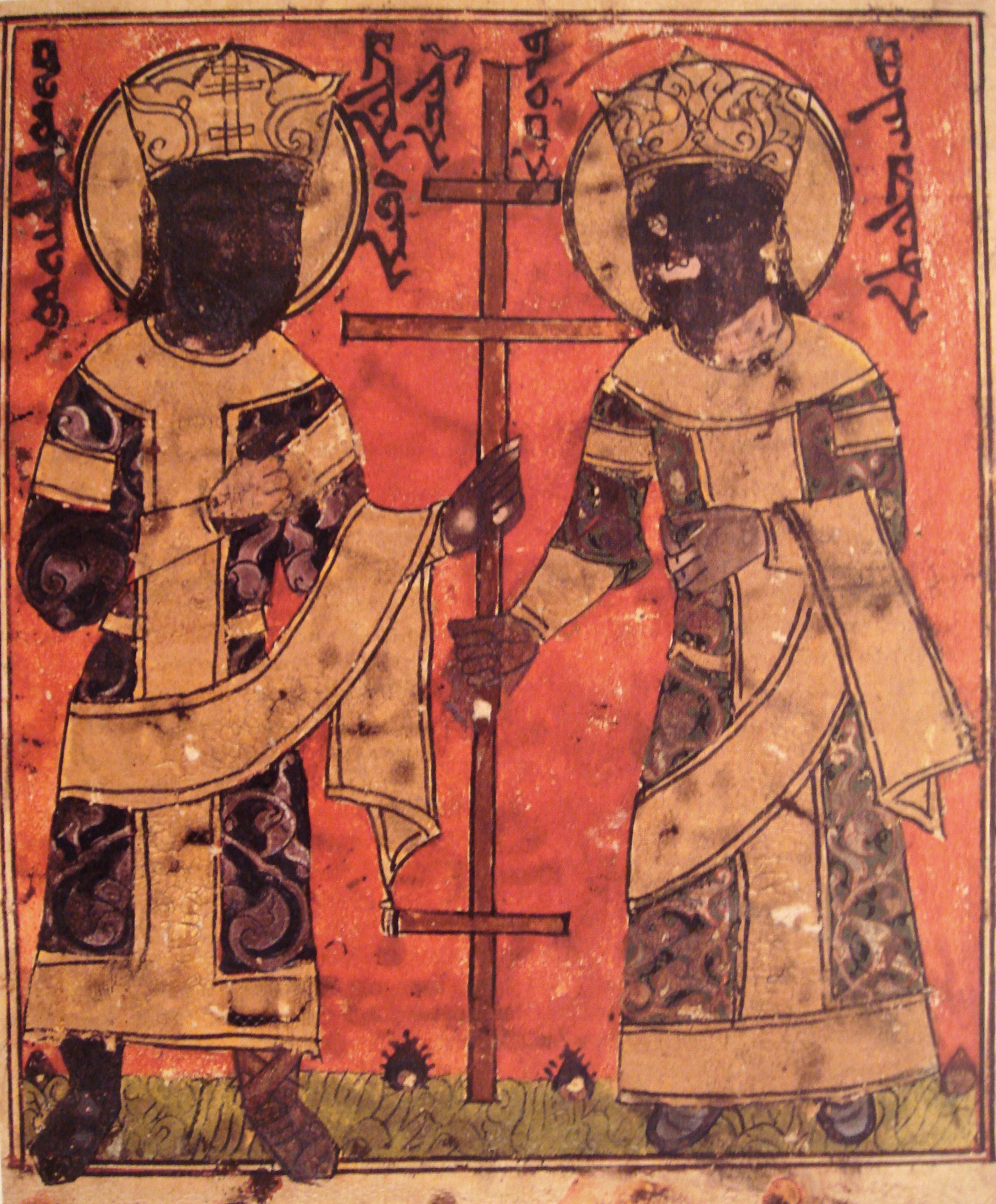
Saint Hülegü and his Christian wife Doguz Khatun depicted as the new "Constantine and Helen" in a Syrian bible

Saint Hülegü and his Christian wife Doguz Khatun depicted as the new “Constantine and Helen” in a Syrian bible

The Fall of Baghdad in 1258 CE

Möngke had charged his brother to destroy all Muslim power bases in the West including the Lurs and Kurds of southern Iran, the Ismaili sect in its almost impregnable fortresses at Alamut (which fell in 1257), the Ayyubid states in Syria and the Mamluks in Egypt. Hülegü was well-known for his ruthlessness. The short siege between 29 January and 10 February 1258, and subsequent fall of Baghdad must be considered as one of the largest massacres and destruction in history. Up to one million inhabitants of the “City of Peace” including women and children may have been killed. The Mongols looted and burned to the ground mosques, palaces and hospitals. Baghdad’s Grand Library which contained hundreds of thousands historical documents and books, actually the knowledge of the whole world, had been destroyed and all books flung into the river Tigris. The century-old irrigation system was devastated. Mesopotomia never recovered from the onslaught and turned into the vast desert of present day Iraq [1]. The Caliph, al-Musta’sim, was probably wrapped in a rug and trampled to death in order to avoid shedding “royal blood”.

However, as George Lane writes in his monograph [2], “[t]he feared and predicted reaction from the heavens and from the Muslim community never happened. No divine or earthly retribution appears to have been visited upon Hülegü.”

“The sacking of Baghdad though brought about by the command of an unbeliever, Hülegü Khan, was carried out by Christian and Muslim troops as well as Mongols and Turks, and some of Hülegü’s closest advisors and strategists were also Muslim including Sunnis. Hülegü was acoompanied on the siege of Baghdad among others by the prominent Atabegs of Shiraz and Mosul and their armies. The destruction of the Abbasid Caliphate cannot be viewed solely as an act by an alien and wanton invader divorced from the reality of the Dar al-Islam. There is little evidence of any great ground swell of grief or despair as news of the caliph’s death spread around the world just as there were no earthquakes, no drought, no failing plants, no outbreak of plague among the troops or horses, and no halt to the Sun’s daily cycle. The only king to die at that time was the caliph.” [3]
Continue reading

Posted in Art, Iran | Tagged , , , , , , , , , , , , , , | Leave a comment

Decades to Come

The appearance of former NSA and CIA director Gen. Michael Hayden on the CBS show Face the Nation on 29 December 2013 has triggered quite a lot of criticism as regards Hayden’s frank lies about whistle-blower Edward Snowden’s two alleged open letters to the Brazilian and German governments in which he had promised to help them in their efforts to investigate illegal NSA spying efforts. Hayden claims, in the interview with Major Garrett,

“[…] In the past two weeks, in open letters to the German and the Brazilian government, he [Snowden] has offered to reveal more American secrets to those governments in return for something — and in return was for asylum. I think there’s an English word that describes selling American secrets to another government, and I do think it’s treason.”

If Snowden had mentioned asylum in the letter to the Brazilian people then probably in order to recall that he had sought asylum in several countries including Brazil in summer last year. He has not sent another letter to the German government but had recently an email exchange with German magazine Der Stern. BuzzFeed knows that, according to his lawyer, Snowden would not trade information for asylum.

What Hayden seems not to understand (and Garrett does not question) is that NSA activities in foreign countries, strong allies in both cases, are illegal and have met with considerable uneasiness. And that Snowden has been asked in particular by German lawmakers, not to reveal more NSA secrets, but to testify in a possible parliamentary court of inquiry.

Continue reading

Posted in USA | Tagged , , , , , , , | Leave a comment

Deadliest Year After 2008 in Iraq

IBC

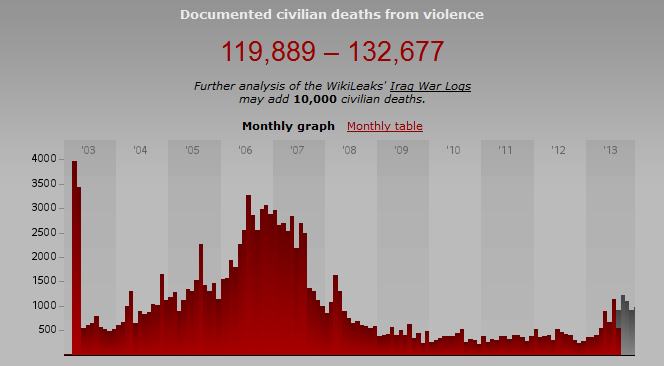
Iraq Body Count’s (IBC) visual update yesterday of total numbers of killed civilians in Iraq since 2003 was long overdue. The many reports that 2013 was the deadliest year after 2008 had not been properly illustrated since so-far not confirmed numbers since August were still missing. The new graph shows preliminary numbers in grey.

The reported civilian death toll in the second year after President Obama had declared end of the war and “a success” sharply increased to 9,475, just short of the 2008 number of 10,130. What is of much concern is that figures were especially rising in the second half of 2013. As IBC’s Lily Hamourtziadou analyzes,

“The initial unprovoked attack of 2003 by one of the world’s most powerful states was the first one. It was followed by years of occupation, insurgency, terrorism and increasingly competing interests. Internally, the interests of the Sunnis, the Shias, the Kurds, the religious fanatics, the secular, the non-Muslim; externally, the interests of the US and the UK, Iran and Syria, all of which want to expand their political and ideological sphere of influence at any cost. Those competing interests led to the internal collapse of Iraqi society and remain the sad legacy of the invasion.

“Iraq is now a fragmented state, where each party struggles to gain power, at the expense of the others, as they have incompatible security requirements, which means that the security of each cannot be assured at the same time as the security of its rivals or enemies. Thus they seek relative gains, where their own gain is a loss to another, rather than absolute gains, which require cooperation. In a state as weak and fragmented as Iraq, all sides see the struggle for power and its acquisition as a means to their survival.

“Al Qaeda in Iraq has found fertile ground in all this discontent and has attacked the Iraqi government, as the Syrian government is being attacked this year, by killing members of its army, its police force, its politicians and journalists, as well as its Shia population. Indeed, the last six months have seen the massacres of entire families, as they sleep, or travel to a holy place, sometimes 5, sometimes 12 family members at a time… The faults are now as wide and as deep as trenches.”

1 January 2014 @ 5:05 pm.

Last modified January 1, 2014.

Posted in Iraq | Tagged , | Leave a comment

Once Bitten, Twice Shy

The news in this CNN clip is not Edward Snowden’s Pope Francis-like pathetic Xmas message on privacy broadcast by British Channel 4 or Glenn Greenwald’s endorsement of it or Dana Bash’s stupid accusation of releasing Snowden’s leaks for “maximum damage” but rather that Harvard University’s Felix Frankfurter chair, notorious Alan Dershowitz seized the opportunity to smear Greenwald after his segment was over. One would have liked to hear Greenwald’s response.

“As far as Greenwald is concerned, he’s an ideologue. I don’t think he would have revealed this information if it had been critical of Venezuela or Cuba or the Palestinian Authority. You know, he doesn’t like America. He doesn’t like Western democracies. He’s never met a terrorist he didn’t like. So he’s a very hard-left ideologue that uses this to serve his political agenda not simply to reveal information in a neutral way. That makes him very different from WikiLeaks, I think.”

Greenwald and Dershowitz had had an argument over a BDS event at Brookly College in February this year. From the beginning of Snowden’s leaks which were mainly published by Greenwald and the Guardian, Dershowitz had claimed that “he [Greenwald] did this because he hates America.” Now, he doesn’t like Western democracies either, but seems to like terrorists, even worse than WikiLeaks.

Dershowitz has previously destroyed the academic career of his strongest critic, Norman Finkelstein, in 2007, some years after a remarkable exchange of blows at Democracy Now! (when Dershowitz’ counterstrikes were more than dull). Maybe Dershowitz shuns a direct confontation with Greenwald for a reason. Once bitten, twice shy.

26 December 2013 @ 8:46 pm.

Last modified December 26, 2013.

Posted in USA | Tagged , , , , | Leave a comment