Understanding the Iranians

President Barack Obama proudly informed us that he had a phone call with his Iranian counterpart Hassan Rouhani yesterday. It seems as if the two are becoming friendly. An earlier attempt of quoting Iranian poet Sa’adi (d. 1291 or 1292) in a Nowruz address in 2010 in order to win hearts and minds of the Iranian people (“The Children of Adam”) has more or less failed. Iranians have read the President of Words’ real face earlier than most of us. Relentless sanctions have destroyed Iran’s economy, and it seems so as if they ultimately bring them back to the negotiation table. (In that regard it is revealing to have another look at Obama’s Nowruz address of 2012 when he castigates the Iranian government’s monitoring and filtering of the internet. Knowing about the NSA surveillance scandal in 2013, Obama’s concerns and self-righteousness have got a stale aftertaste.)

The telephone call between Obama and Rouhani is considered historical by many after 34 years of cold war between the two countries. Reportedly, Rouhani concluded the call by telling Obama, “have a nice day.”

I am afraid Obama needs to attend a crash course in understanding the Iranians. I had immediately American-Iranian Hooman Majd in mind who explained the Iranian soul a couple of years ago in his bestseller “The Ayatollah Begs to Differ”. What is most pertinent is ta’arouf, haqq, and taqiyeh.

Amiableness is usually exaggerated. It’s ta’arouf. It must not be regarded personally nor honest.

Haqq is the Iranian’s obsession with their “rights”. Of course, they have the right to enrich uranium, even for whatsoever. Deep in any Iranian soul is hidden that they have always been treated unjust and deprived of their fundamental rights. But that they will prevail anyway. It originates, of course, from the martyrdom of the Prophet Muhammad’s grandson and third Shi’a Imam Husayn in Kerbala in 680 CE. And not least in the long history of a country which never conquered but had been conquered so often, beginning with Alexander, the Arabs, the Seljuqs, the Mongolians, Timur’s hordes, and, lately, humiliated by the British and the Great Satan, the Americans (did I forget someone?). But fortunately, due to the righteousness of the Iranian people, all had eventually been or will be Persianized.

In order not to be unlawfully killed (remember, all but one of the twelve Imams had been assassinated), Shi’ite Iranians had adopted taqiyeh, or dissimulating their faith to ultimately assure survival, as a religious duty.

So, Obama should expect the new negotiation team which world powers P5+1 will encounter in Geneva in mid-October will practice taqiyeh at its best. Talks about the Iranian nuclear program will be lengthy and full of ta’arouf while the Iranian delegation will thump their haqq.

As it was before.

28 September 2013 @ 3:40 pm.

Last modified September 28, 2013.
Posted in Iran, USA | Tagged , , , , , , | Leave a comment

Climate Change has been Changing the World

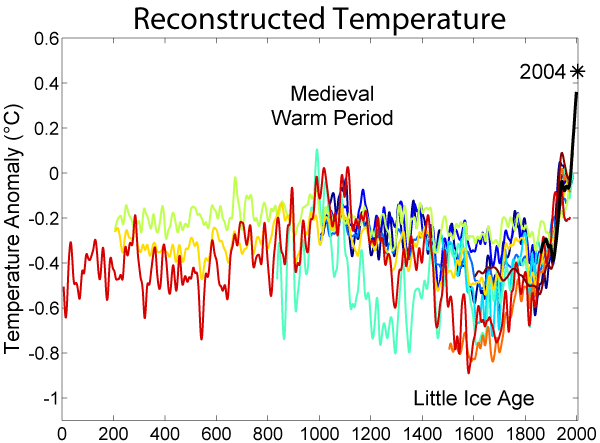
A comparison of ten different published reconstructions of mean temperature changes during the 2nd millennium. More recent reconstructions are plotted in redder colors, older reconstructions appear in bluer colors. An instrumental history of temperature is also shown in black. The medieval warm period and little ice age are labeled at roughly the times when they are historically believed to occur, though it is still disputed whether these were truly global or only regional events.

A comparison of ten different published reconstructions of mean temperature changes during the 2nd millennium. More recent reconstructions are plotted in redder colors, older reconstructions appear in bluer colors. An instrumental history of temperature is also shown in black. The medieval warm period and little ice age are labeled at roughly the times when they are historically believed to occur, though it is still disputed whether these were truly global or only regional events.

The 2013 report by the Intergovernmental Panel of Climate Change (IPCC) and a summary of the huge volume can be found here. It is possible that the rise and fall of huge empires during the past thousand or two thousand years coincided with climate change. Juan Cole has related the decline of the Safavid and Mughal empires in the late 17th and early 18th centuries to the Maunder Minimum of solar activity between 1645 and 1715 CE leading to a period with low temperature. The Maunder Minimum coincides  with what is known as the “Little Ice Age” which in turn saw the Thirty Years’ War in Europe (1618-1648).

A couple of centuries before the rather low temperatures in the 17th and 18th centuries, world enjoyed what is called the “Medieval Warm Period” around 900-1200 CE. It saw the rise of some of the largest empires in history, in particular the Mongolian Empire. A theory tells that their most eminent (and cruel) Emperor Chengis Khan (d. 1227) may have reverted the trend and successfully scrubbed 700 million tonnes of carbon dioxide from the atmosphere. The world’s greenest conqueror ever. During the Mongolian invasions in the 13th and 14th centuries he, his successors and their hordes conquered an incredible 22% of the world’s total land area and possibly killed 40 million people. One significant side effect may have been widespread reforestation of depopulated areas which led to more carbon absorbed from the atmosphere.

Research done by Julia Pongratz of the Carnegie Institution for Science’s Department of Global Ecology indicates that “humans started to influence the environment thousands of years ago by changing the vegetation cover of the Earth’s landscapes when we cleared forests for agriculture.” Long-lasting invasions and carnage such as the Mongolian and the conquest and depopulation of the Americas (1519-1700) may in fact have had a dampening impact on man-made carbon dioxide emission and a strong effect on regrowth of forests, short-lived plague outbreaks in Europe (the Black Death in 1347-1400) and the Fall of the Ming Dynasty in China (1600-1650) had probably not.

The Mongolian invasions which probably have been sparked by so far unexplained climate change (higher temperatures and extensive rain fall in Mongolia might have led to more favorable living conditions in vast areas of East Asia and Eurasia) were preceded by another huge empire, that of the Great Seljuqs (1037-1134). This dynasty of steppe nomads, which trace their origin to Seljuq (d. 1038)  who served in the Khazar army before he converted to Islam, defeated the Byzantines at Manzikert in Anatolia in 1071, fought the Crusaders, and is generally considered responsible for the Sunni Revival of the 11th and 12th centuries. Under their governance Iran saw its first, in a long series, climax of culture after the Arab conquest in the 7th century. Has it been climate change (the “Medieval Warm Period”) forcing them to seek new pastures in the Iranian plateau and Anatolian highlands?

Where are we escaping after Earth has become inhabitable? Terraformed planets?

28 September 2013 @ 9:56 am.

Last modified December 29, 2014.

Posted in Uncategorized | Tagged , , , , , , | Leave a comment

Rouhani, Obama Both Liars?

David Albright and Christina Walrond at the Institute for Science and International Security (ISIS) make the point, in a recent piece on ISIS’ webpage, that new elected Iranian president Hassan Rouhani, in a series of overtures to the United States to overcome 34 years of “Cold War mentality” between the two countries, had lied when claiming, in an interview with Ann Curry of NBC, “We have never sought nor will ever seek nuclear weapons. We solely seek peaceful nuclear technology,” referring to the now notorious 2007 National Intelligence Estimate on Iran (NIE). (Emphasis added.)

In that document, which had been published in November that year to the dismay of then President G.W. Bush and Vice President Dick Cheney had stated that, “We [the 16 separate U.S. government intelligence agencies] judge with high confidence that in fall 2003, Tehran halted its nuclear weapons program; we also assess with moderate-to-high confidence that Tehran at a minimum is keeping open the option to develop nuclear weapons.” And (followers are urged to read the unclassified part of the 2007 NIE here [pdf]),

“We assess with high confidence that until fall 2003, Iranian military entities were working under government direction to develop nuclear weapons.

We judge with high confidence that the halt lasted at least several years.

We assess with moderate confidence Tehran had not restarted its nuclear weapons program as of mid-2007, but we do not know whether it currently intends to develop nuclear weapons.”

As far as we know, for instance from investigations by Seymour Hersh, a highly classified 2011 NIE had stated in essence still the same: Iran has halted it nuclear weapons program in 2003; it has not restarted it then but keeps the option to develop nuclear weapons open. So, accepting U.S. intelligence estimates that Iran had a nuclear weapons power until fall 2003 when Hassan Rouhani was actually Iran’s top nuclear negotiator, he frankly lied to Ann Curry (provided the interpreter had got it right).

(Albright and Walrond refer to the controversially discussed annex of the November 2011 IAEA report [pdf] on Iran in which, based on information by unnamed “member states”, the IAEA assesses that “[t]here are […] indications that some activities relevant to the development of a nuclear explosive device continued after 2003, and that some may still be ongoing.” The annex has been controversially discussed because of several factors. Iran has rejected its conclusions as they were allegedly based on fraud.)

And what does President Barack Obama do? Provided U.S. intelligence estimates on Iran are trustworthy, he continues misinforming the public about Iran’s nuclear bomb ambitions in 2013. So, either the unclassified part of the 2007 and highly classified 2011 NIEs are incorrect or both folks are liars.

A brief remark on NBC’s Ann Curry in Tehran. Listeners to the interview get easily the impression of a harmless, naïve and uninformed inquirer. Her interview of Rouhani’s astute predecessor Mahmoud Ahmadinejad in 2011 has not been forgotten. When Rouhani said, “We never sought”, a better-informed (of the 2007 NIE) reporter should have interrupted him immediately rather than to confuse him and her audience with “yes” or “no” statements.

22 September 2013 @ 8:47 am.

Last modified September 22, 2013.

Posted in Iran, USA | Tagged , , , , , , , | Leave a comment

Germany’s Pope of Letters R.I.P.

Marcel Reich-Ranicki passed away yesterday at the age of 93. His remarkable life as survivor of the Warsaw Ghetto and, in post-World War II Germany, his rise as the number one literary critic of German literature had been told in his autobiography of 2001. With him we lose one of the last contemporary witnesses of the Holocaust. What happened afterwards was unconditional embrace of what he thought make Germans humane at last, their literature and music. I had written, in a completely different context, about Reich-Ranicki,

“[H]e described [in his autobiography] in his own unpretentious way the incredible situation of the people in the Ghetto and his and his young wife Tosia’s miraculous escape from hell (Umschlagplatz) only minutes before being deported to the gas chambers of Treblinka’s extermination camp. Reading this is both thrilling and mortifying. The industrial perfection of genocide, the Holocaust of Jews and others will forever, at least for the coming generations, be the inhumane stain on Germany and Germans.

“What is more amazing with Marcel Reich-Ranicki’s biography is his deep love for his and all the Jews’ German tormentors’ literature and composed music. Is it a sort of love-and-hate relationship? Does he want to prove that human bestiality and striving for the highest cultural achievements does not exclude each other? Has he forgiven “the” (or some) Germans or is he paying back when publicly delivering his often harsh judgments on hopefuls in the literature business?”

Well, at least as regards the two latter, the answers may be “yes, indeed.” A very personal way to come to terms with the egregious bestiality of German executioners he had experienced. With very much respect, maybe he had felt, not very much hidden in his straight personality, an own dark side, which might have surfaced when relentlessly criticizing and even condemning some of post-war Germany’s most celebrated writers: Hesse, Böll, Grass, Walser.

The context I had written about Reich-Ranicki was when U.S. President Barack Obama committed his first capital sin in a long row, shortly after he had taken office in 2009: pardoning CIA agents for conducting torture-like so-called enhanced, interrogation techniques to detainees in Iraq and Afghanistan and preventing the release of photographs taken at Abu Ghuraib prison camps.

American crimes are not to be compared with the Holocaust. But truth and justice must (and will) prevail. It may take a long time.

19 September 2013 @ 8:01 am.

Last modified September 19, 2013.


Posted in Germany | Tagged | Leave a comment

Obama Cornered?

Obama02

Only days ago, President Barack Obama was about to unleash war on Syria, whose government had caused hundreds of deaths on 21 August when having ordered the use of chemical weapons on rebel strongholds in Ghouta east of Damascus, even without congressional support. A strange “Governmental Assessment” (in order words, his own estimate) had not convinced a majority of the Senate or the House nor the American people nor anybody reasonable outside the U.S. “A preliminary U.S. government (sic!) assessment determined that 1,429 people were killed in the chemical weapons attack, including at least 426 children, though this assessment will certainly evolve as we obtain more information,” was overly precise and significantly deviates from intelligence information of the UK’s Joint Intelligence Organisation (“at least 350 fatalities”) and probably France.

Fact of the matter is that, in the meantime, his Russian counterpart, Vladimir Putin, has temporarily saved Obama from a serious political defeat. He actually saved Obama’s face with a new diplomatic initiative aiming at getting Syria’s arsenal of chemical weapons under international control (an impossible mission, by the way, in the civil war-stricken country) and ultimately destroy them. Bashar al-Assad, for the first time, admitted to even possess chemical weapons, pledged to sign the international Chemical Weapons Convention, and unsurprisingly formulated preconditions: the U.S. stops threatening to strike Syria and stops arming rebels.

Putin’s remarkable op-ed the New York Times the other day in which he disagreed (actually speaking for all of us) with Obama’s nationalistic claim that the United States’ policy is “what makes America different. It’s what makes us exceptional,” has led to but a tiny storm in the mainstream media. It is in fact “extremely dangerous to encourage people to see themselves as exceptional, whatever the motivation.”

It seems, Obama has buckled. He would no longer push in the UN Security Council for military action in Syria. It is hoped that he has, after his dispensable address to the nation of Tuesday this week, understood a lesson. American foreign policy is not measure of all things. Rather the opposite. Obama, who has been one of the worst American presidents in his first term already, may eventually realize that he has failed in all fields. The high expectations he had nurtured with a couple of outstanding speeches, after G.W. Bush’s disastrous foreign adventures, are going to backfire.

An angry Noam Chomsky stressed on Wednesday in DemocracyNow! a couple of simple facts,

“[H]e [Obama in his remarks in address to the nation on 10 September] said that for seven decades the United States has been ‘the anchor of global security.’ Really? Seven decades? That includes, for example, just 40 years ago today, when the United States played a major role in overthrowing the parliamentary democracy of Chile and imposing a brutal dictatorship, called ‘the first 9/11’ in Latin America. Go back earlier years, overthrowing the parliamentary system in Iran, imposing a dictatorship; same in Guatemala a year later; attacking Indochina, the worst crime in the postwar period, killing millions of people; attacking Central America; killing—involved in killing—in imposing a dictatorship in the Congo; and invading Iraq—on and on. That’s stability? I mean, that a Harvard Law School graduate can pronounce those words is pretty amazing, as is the fact that they’re accepted without comment.

“The appropriate response [after Russia’s diplomatic initiative aiming at getting international control over Syria’s chemical weapons] would be to call for imposing the chemical weapons convention in the Middle East—in fact beyond, but we’ll keep to the Middle East—which would mean that any country that is in violation of that convention, whether it has accepted it or not, would be compelled to eliminate its chemical weapons stores. Just maintaining those stores, producing chemical weapons, all of that’s in violation of the convention, and now is a perfect opportunity to do that. Of course, that would require that U.S. ally Israel give up its chemical weapons and permit international inspections. Incidentally, this should extend to nuclear weapons, as well. The further step would be to move towards the kinds of negotiations, Geneva negotiations, that the U.N. negotiator, Lakhdar Brahimi, has been calling for, with Russian support and with the United States kind of dragging its feet.”

14 September 2013 @ 9:45 am.

Last modified September 14, 2013.

Posted in Russia, Syria, USA | Tagged | Leave a comment