Stretching Its Mandate to the Limit

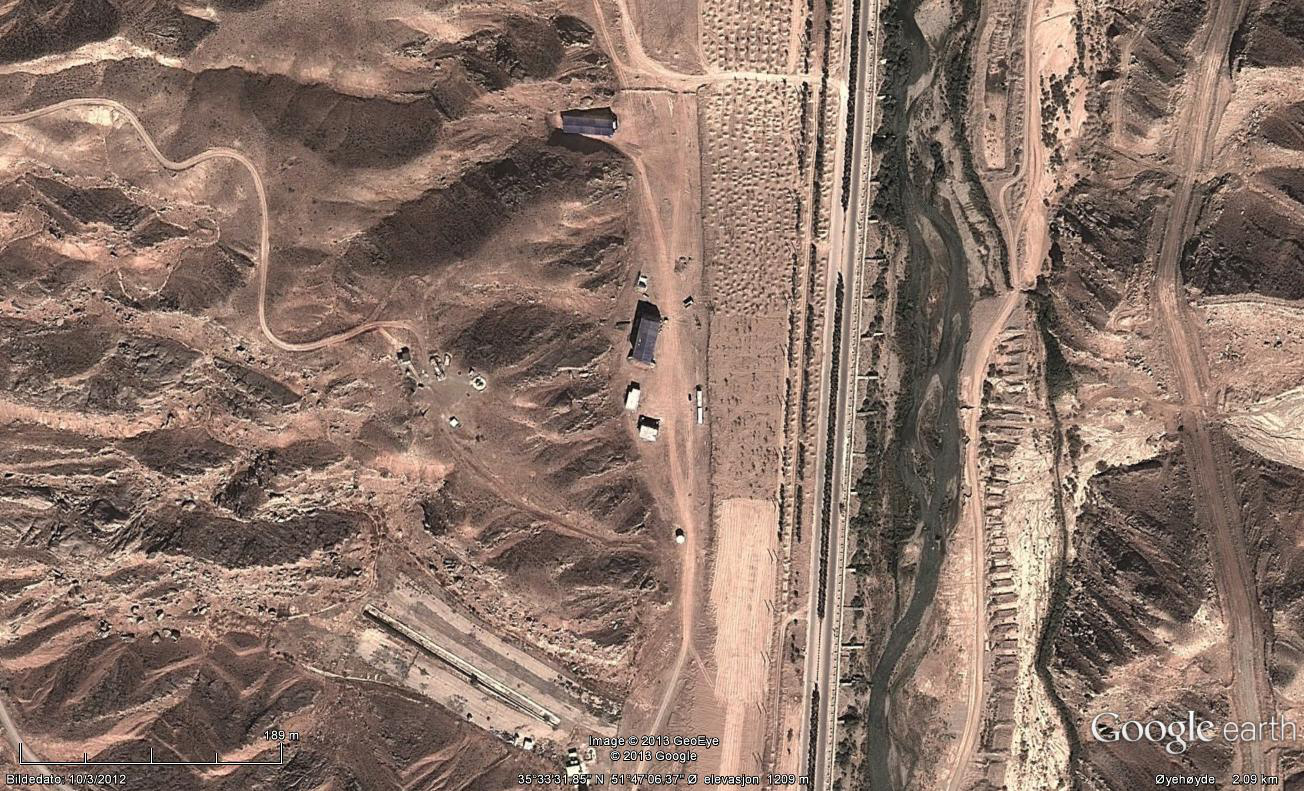
Parchin_7 (3-10-12)

In further distracting attention from Iran’s obligations as regards its nuclear program, the recent attempt by Herman Naeckerts and his IAEA team of negotiators to gain access to the Parchin military complex 30 km southeast of Tehran just failed again, as did previous enterprises in this regard. For obvious reasons, as Iran continues to describe the alleged evidence of that it had conducted illicit experiments with high explosives in a certain building on the vast complex a decade ago as fabricated as long as it has no chance to have a look at it. A further meeting has been  scheduled for February 12.

As a matter of fact, the respective site at Parchin with its two bigger buildings and a couple of garages or toolsheds had undergone considerable construction/renovation work since March 2012 (after years of no activity), and one small building had actually been demolished before May 25, 2012, as can be seen on GoogleEarth satellite images below (encircled).
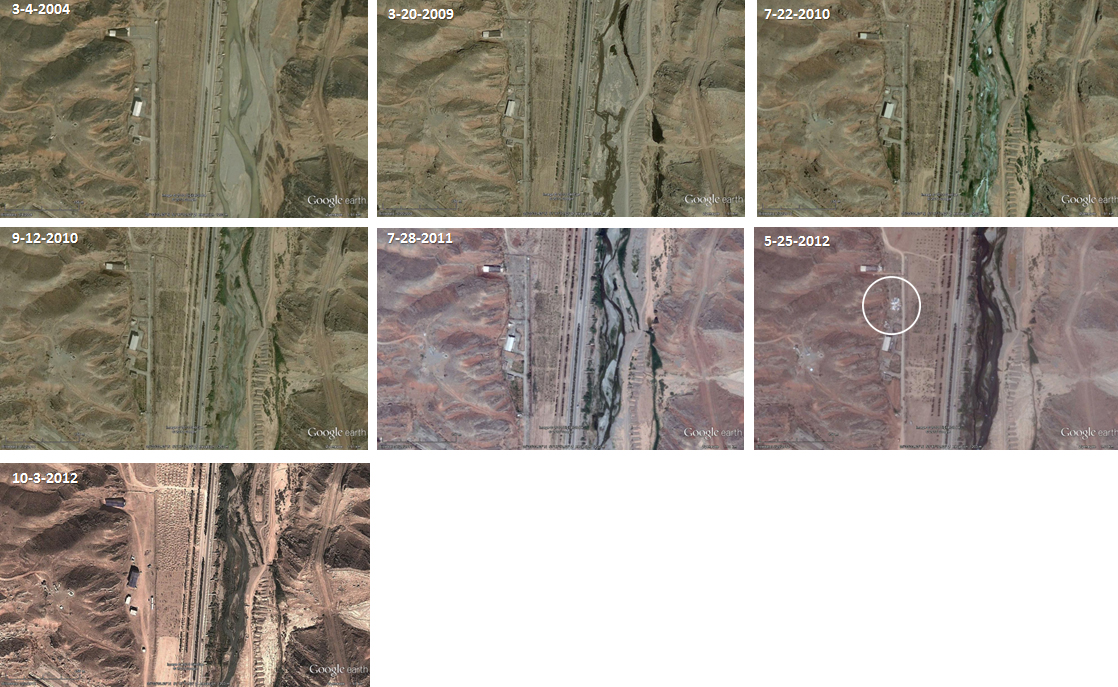
Parchin_timeline

Iran’s agenda when drawing attention apparently by intention to the suspect site, which is right now under permanent scrutiny via satellite imaging, by obvious construction/renovation work (including hitting-the-eye covering the two main buildings with flashy pink tarpaulins) is not clear at all. No matter of whether illicit experiments with high explosives had been done before 2003, they might have been conducted elsewhere, at Parchin or, for instance, at the site at Marivan (which is close to the site where three American hikers had crossed the Iranian border with Iraq in June 2009 who had then been arrested by Iranian border patrols) which is also mentioned in the November 2011 report by IAEA DG Yukiya Amano. It is also possible that Iran does create ambiguity by purpose only to be relieved when nothing was found at the Parchin site after IAEA inspectors were eventually granted access.
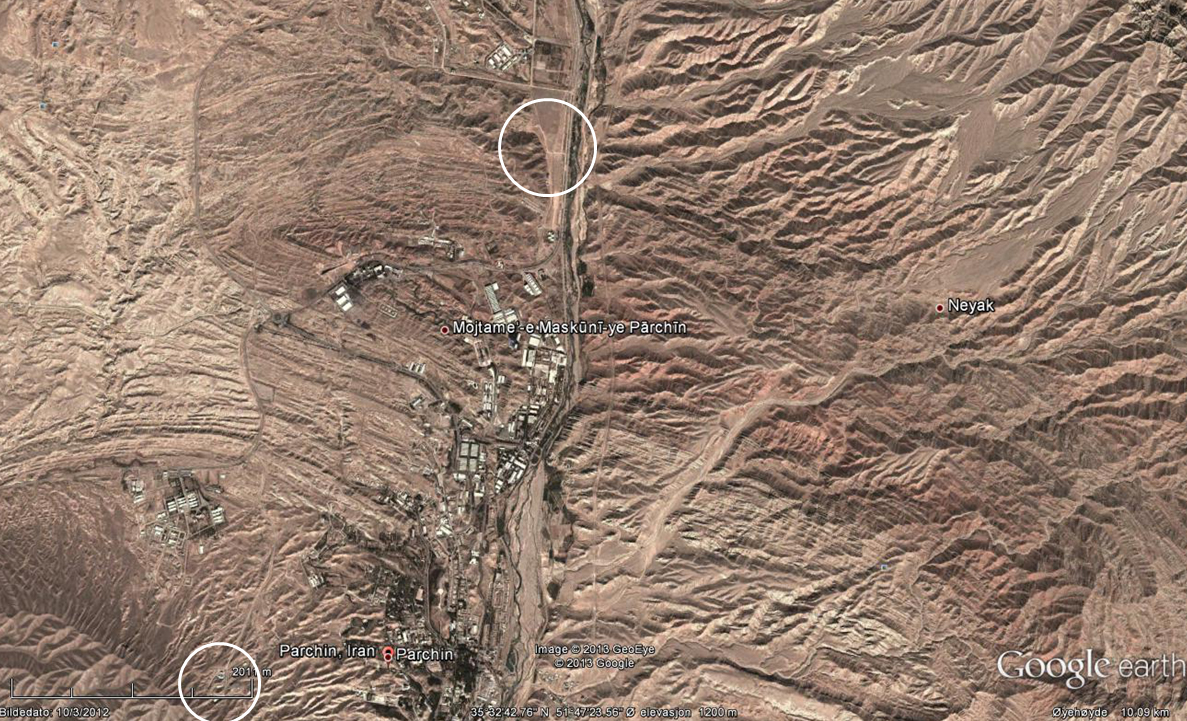
Parchin_tunnel01

That conducting illict experiments with high explosives in a building (partly sealed off by an infamous berm) do not make too much sense was stressed yesterday by former IAEA director of nuclear inspections in Iraq, Robert Kelley. Tunnels would do better. There seems to be better locations at Parchin. Kelley exemplifies an area close to the main complex (encircled at the bottom of the satellite image), about 5 km southwest to the suspect building site (top).
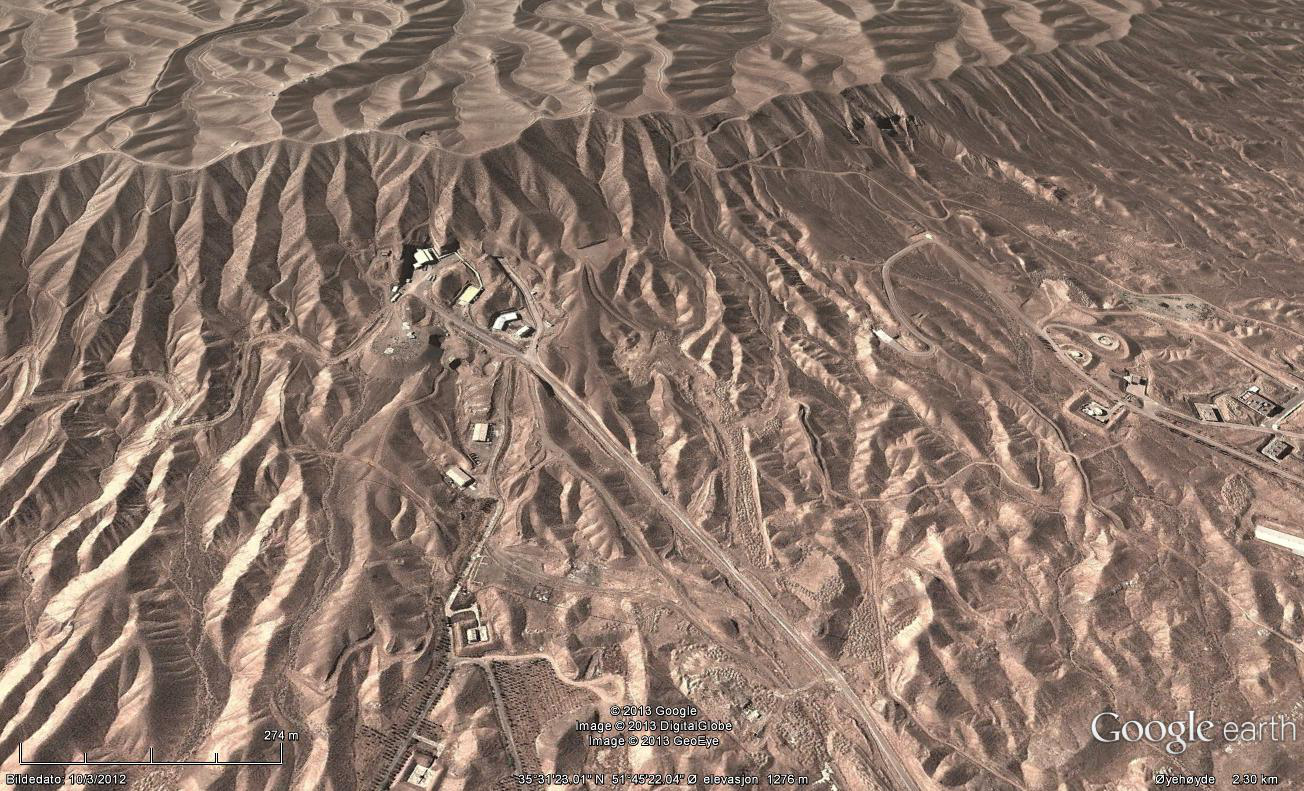
Parchin_tunnel04

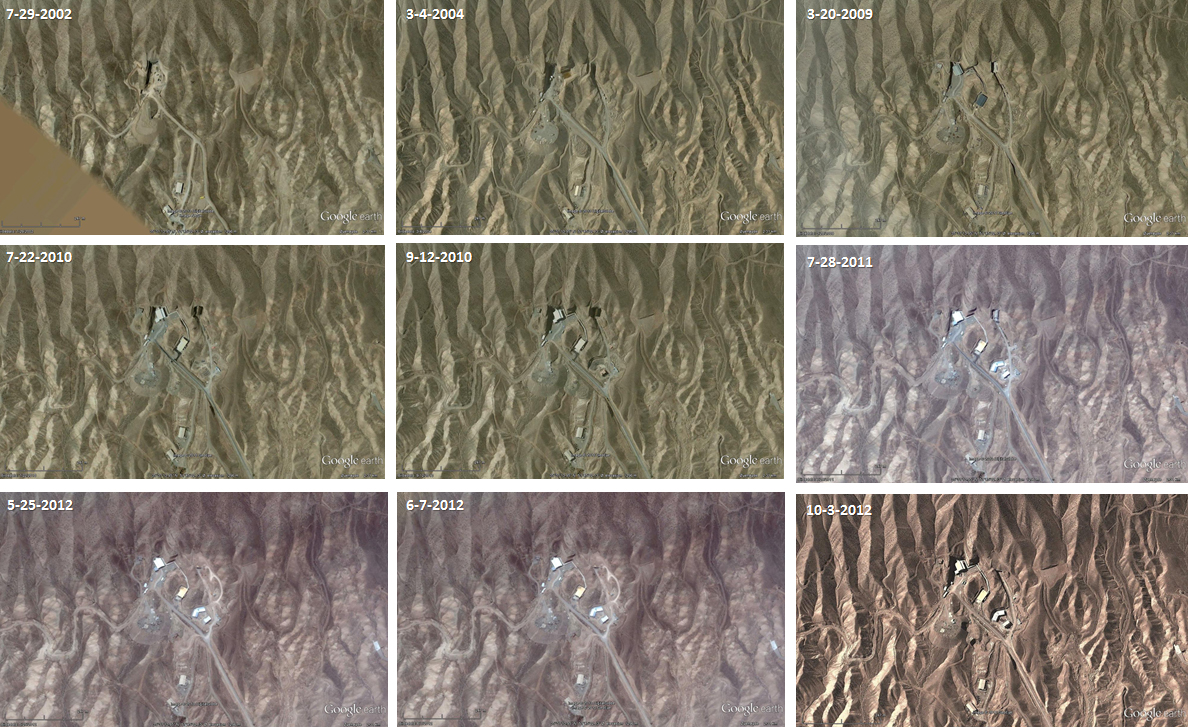
It consists of a number of buildings and apparently entrances for tunnels dug deep into the mountain. In spite of the possibility that Iran is still conducting experiments with high-explosives, it is, however, unlikely that before 2003 the site had been active. GoogleEarth provides timeline images which indicate that major tunnel construction activities only started after 2004 (in 2005, President Mahmoud Ajmadinejad, a downright tunnel expert by education, had been elected for the first time).
Parchin_tunnel02

Anyway, the ongoing Parchin charade about alleged experiments which have or have not  been conducted a decade ago has largely distracted attention and has quickly to be solved. Kelley suggests something new.

“What is needed is a new approach. The IAEA is stretching its mandate to the limit in asking for access to a military site based on tenuous evidence. The UN Security Council should step in and negotiate a visit to Parchin by a non-IAEA international team. That team could include experts with much greater experience than the IAEA can deploy and come to technical judgements about the site. If nothing nuclear is found then the IAEA has no grounds for complaint. If something nuclear is found then the IAEA will be vindicated and will need to become seriously engaged in the follow-up investigation.”

19 January 2013 @ 11:42 am.

Last modified January 19, 2013.
Posted in IAEA, Iran | Tagged , , , , , | Leave a comment

Turkey Shoot

Highway of death

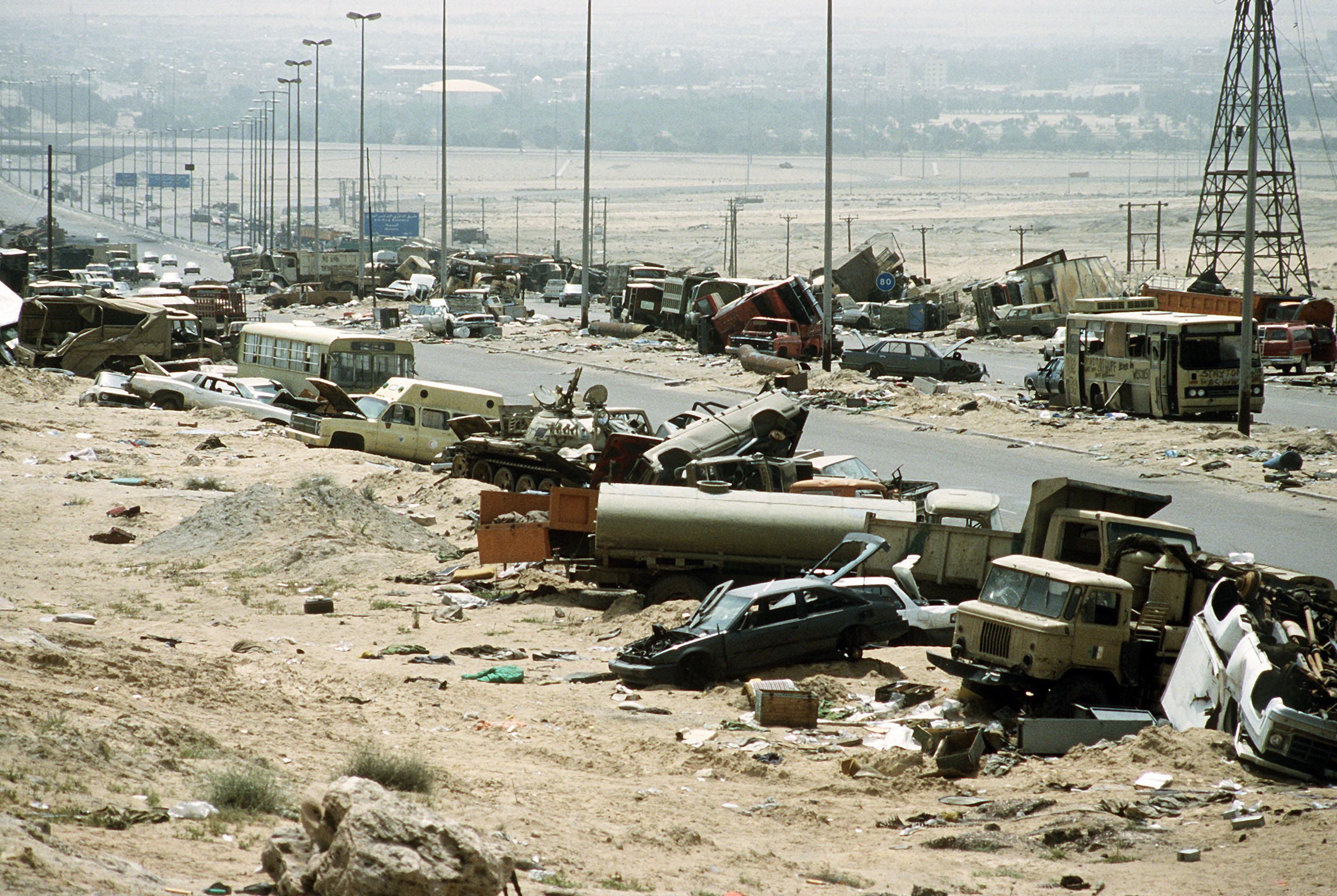
On the night between 26 and 27 of February 1991 a massacre took place on highway 80 in Kuwait. Thousands of Iraqis had been caught in a long convoy while retreating to the Iraqi border. American airplanes had first blasted (mostly civilian) vehicles, which had definitely been stolen from Kuwaitis, in the front and rear of the convoy on the road to Abdaly. The trapped convoy was then bombed relentlessly by wave after wave of attach aircraft, Warthog, and Apache helicopters with cluster bombs, missiles and machine gun fire. That has been called Turkey Shoot afterwards.

A completely misled US Warthog pilot told reporters a couple of days after the war crime enthusiastically,

“There’s just nothing like it, … “It’s the biggest Fourth of July show you’ve ever seen, and to see those tanks just go ‘boom,’ and more stuff just keep spewing out of them and shells flying out to the ground, they just became white hot. It’s wonderful.”

Then Commander of “Operation Desert Storm”, “Stormin’ Norman” Schwarzkopf, who had died yesterday from complications after pneumonia at age 78, justified the death of up to ten thousand Iraqis in an interview aired in January 1996,

“Why did we bomb them? Because there was a great deal of military equipment on that highway. I had given orders to all of my commanders that I wanted every piece of Iraqi equipment that we possibly could destroyed. This was not a bunch of innocent people just trying to make their way back across the border to Iraq. This was a bunch of- of rapists, murderers and thugs who had raped and pillaged downtown Kuwait City and now were trying to get out of the country before they were caught.” (Emphasis added)

Rapists, murderers and thugs, sort of people involved in any war, I am afraid. You may see the kind of vehicles on what is now known as Highway of Death, including transport buses and indeed one tank, on the picture above. American film director Sam Mendes had used pictures of the incinerated bodies in burnt-out vehicles which had been encountered, after the act, by clueless and bored, unavailingly trigger-happy American ground soldiers in a drama scene of his moderately apt Jarhead of 2005.

The second Gulf War (after the Iran-Iraq war of the 1980s) then lasted for twenty years. Kuwaitis have cleaned up the site in the meanwhile, and when leaving Kuwait City and driving either north toward Abdaly or east to Bubiyan Island (another American target on that particular night), no conspicuous wreckage would be visible anymore.

28 December 2012 @ 12:18 pm.

Last modified December 28, 2012.

Posted in Iraq, Kuwait, USA | Tagged , , , , , | Leave a comment

The Expert Who Never Was

Why has  the notorious November 27 graph published by George Jahn and Associated Press (AP), allegedly proving Iran’s possible military dimensions (PMD) of its nuclear program not been a hoax as several pundits have asserted in the meantime? Israel has been accused of having leaked, to the AP, stolen information about the IAEA’s own investigation of Iran’s nuclear PMD, which seems to be quite credible.

Now, David Albright, founder and president of Washington D.C.-based Institute for Science and International Security (ISIS), had given a power point presentation (where? when?) explaining  why it probably was not. He couldn’t help since (as is obvious from his presentation) he was asked by AP (see slide 7/24).

“Just prior to the AP’s publication of the first article, I was asked to comment on the graphs by the AP (…). I have often assessed leaks to the media about the Iranian nuclear program and am skeptical about these leaks. I said that the explosive yield appeared too high to reflect an actual Iranian nuclear weapon design, assuming that such a design existed.

Upon learning after the publication of the error in the units, I analyzed the graph confirming the error but also I calculated that correct units were “joules per 10 nanoseconds” or “joules per shake.” A shake is a term from the Manhattan Project and refers to the short time frame between neutron generations in a nuclear explosion.

With those units, I estimated the area under the yield rate curve and derived an answer close to the total yield of about 50 kilotons (see two slides down).

The AP published my results in its second story along with a correction of its original claim.”

So, although Mr. Albright had been “skeptical about the leak[s]” as usual and had even noted “that the explosive yield appeared too high” the embarrassing graph was published. Only “[u]pon learning after the publication of the errors in the units”, he actually bothered to analyze the graphs in detail and, well, just confirmed what had been published by others so far. This is not very much credible.

On slide 9/24, Albright tries to make sense of the graph by calculating the area under the yield rate curve ending up with energy yield of “61 ktons” which is definitely not close to 50 kilotons as claimed on slide 7/24 and in the November 30 follow-up article by George Jahn. What follows in Albright’s power point presentation (“Subsequent Developments”, slides 10/24 through 19/24) is some further lofty speculation of what the Iranians had probably in mind when having produced this apparently nonsensical graph. This seems not to be his original research but the result of his consultation of Mark Gorwitz, an “ISIS consultant” and “world-class expert in open source nuclear technical literature”, whatever that may mean. However, Albright’s first judgment (when having been asked by George Jahn) was quite different, as Muhammad Sahimi, Professor of Chemical Engineering and Materials Science and the NIOC Chair in Petroleum Engineering at the University of Southern California, writes.

“As for Albright, according to Jahn he “said the diagram looks genuine but seems to be designed more ‘to understand the process’ than as part of a blueprint for an actual weapon in the making.” That is the level of understanding of the president of Institute for Science and International Security, which is essentially a mouthpiece for Yukiya Amano of the IAEA.” (My emphasis.)

So, what is actually Mr. Albright’s level of understanding, who holds an MSc in physics of Indiana University and  another in mathematics from Wright State University? Has he been “a former U.N. weapons inspector” as has been claimed whenever he had been asked by mainstream media about Iran’s allegedly illicit nuclear program? Definitely not. What appears time and again, though, is that Mr. Albright and his Institute for Science (sic!) and International Security pretend, when using obscure observations (be it from satellite images of, for instance, activities at the Parchin’ military complex or leaked, “by officials from a country critical of Iran’s atomic program”, and presumably faked, information), to prove what cannot be proved, namely that Iran is a nuclear threat to the world.

Amazingly, David Albright now seeks support from former Deputy Director General of the IAEA Ollie Heinonen, who writes (on slide 24/24), rather down-to-earth,

“Let us, however, look at facts. The graphs are just part of the information. We should not conclude too much from them. The graphs are part of a report. It would be good to know what is the actual content and text of that report, the scope of it, authors, etc. Then one can put such a report into its right context.

Then the report, including its contents, authors, and timing, has to be compared against other information, which is available (e.g. to the IAEA). This other information includes other reports, documents, publications, procurements, other individuals and known organizations, all of which give a broader picture of activities going on in Iran. Some of it is hard verifiable facts, and some of it is information which requires clarifications. The key question is then, does this information point in the direction of undeclared nuclear activities or non-peaceful use of nuclear energy? The IAEA conclusion has been for years that the information in its hands is sufficient to raise such questions with Iran, and ask them for clarifications. Some of the activities, perhaps even the graphs, can be explained by work to protect people, including in the military, from nuclear fall-out. But there are many items, such as the detonation experiments, work on neutron sources, the missile reentry vehicle, and uranium metallurgy, which do not serve radiological defense purposes.”

So, let us look at facts. Does leaking such a graph, which might even “be explained by work to protect people, including in the military, from nuclear fall-out” have a meaning other than misinforming and misleading the public by baseless speculation?

22 December 2012 @ 11:45 am.

Last modified December 22, 2012.

Posted in IAEA, Iran | Tagged , , , , , , | Leave a comment

Obama’s Tears

My thoughts these days are with the parents and victims of last week’s carnage in Newtown, CT. These shooting sprees have conspicuously amassed in recent years in the U.S. and no wonder that apologetic supporters of America’s Second Amendment to its Constitution, which reads,

“A well regulated militia, being necessary to the security of a free state, the right of the people to keep and bear arms, shall not be infringed,”

often seem to refer to 9/11 as the beginning of the nation’s militarization. After a decade at “war against terror”, which has long become an endless Global War on Terror, a completely militarized society frantically endorsing military involvement on most continents, the sole superpower after the fall of the Soviet Union has become a menace to everyone. A nation which apparently tolerates torture of its captured enemies. With a Commander-in Chief and Nobel Peace laureate with a personal kill list.   With a President challenging its Constitution’s First Amendment by relentlessly prosecuting alleged whistle-blower Bradley Manning who celebrates today his 25th birthday under arrest for 900 plus days. At times kept in a cage or nude like an animal.  “He broke the law”, the Commander-in-Chief  had already decided in public. One wonders whether Obama has anything but a gut feeling of what is actually important in the 21st century, America’s First or Second Amendment to its Constitution.

President Obama did not shed tears, at least not in public, when Staff Sergeant Robert Bales killed nine children and seven adults in a killing spree in March this year in Afghanistan’s Kandahar province. These children were beautiful, too. As was reported, “blood money” had been paid to parents. Beautiful children were also among those thousands killed in drone attacks in Afghanistan, and Pakistan ordered by President Obama. Did he shed tears when he had heard about that?

17 December 2012 @ 7:27 pm.

Last modified December 17, 2012.

Posted in USA | Tagged , , , , , , , , | 1 Comment

News from Parchin

Now as roofing two buildings at the Parchin military complex east of Tehran has nearly been completed, we get another chance of having a look from space thanks to David Albright’s Washington think tank ISIS who has kept us up to date. A lot has been achieved there since April when satellite pictures had indicated what resembled a vigorous spring cleaning using even quite a lot of water. After having removed now glaring pink tarps, the new roofs appear pleasantly blue. The area around the two buildings has been leveled and even some gardening seems to have taken place with piles of (garden?) mold neatly assembled probably for further beautification.

The problem is that one of the buildings has been identified by the International Atomic Energy Agency (IAEA), indicated by its Director General Yukiya Amano in his November 2011 report, as having been constructed for illicit experiments with high-explosives in the early 2000s,

“49. Other information […] provided by Member States indicates that Iran constructed a large explosives containment vessel in which to conduct hydrodynamic experiments. The explosives vessel, or chamber, is said to have been put in place at Parchin in 2000. A building was constructed at that time around a large cylindrical object at a location at the Parchin military complex. A large earth berm was subsequently constructed between the building containing the cylinder and a neighbouring building, indicating the probable use of high explosives in the chamber. The Agency has obtained commercial satellite images that are consistent with this information.”

Probably the same member state(s) which leaked the rather ridiculous graph the other day to Associated Press’ George Jahn which is supposed to prove Iran’s interest in computer simulations of nuclear test and which has been debunked by so many people in the meantime that I find it hard to write something halfway intelligent about it.

Parchin_4 (28-7-11)

Well, when having visited Parchin in 2005 twice, IAEA inspectors were not able to locate these rather peripheral two buildings (encircled at the top of the picture) inside this huge complex. Iran has not granted again access, which has been requested by the IAEA since Amano’s report, while work went on and ISIS reported regularly, not noticing that its founder and president David Albright made himself a laughing stock when asking IAEA’s DG and the Board of Governors the urgent question, “what should now be done about Iran’s continued refusal of a legitimate request for access combined with its alterations of the site?”

Indeed, what should be done? Does IAEA has a mandate to visit the site? Well, there seem to be different opinions about that. Would it help if Iran would provide access? If one actually assumes what Albright and others fear, what are the consequences of a visit? Supposed they have actually been conducted in the early 2000s (and, according to the 2007 NIE, abandoned in 2003), IAEA inspectors certainly would still find evidence for illicit experiments with high-explosives. Nuclear experiments cannot be undone just by cleaning buildings and removing and replacing soil. Even if they won’t find anything, with all these heavy construction work at the site in recent months Iran would not become a credible and responsible player overnight.

So, consequences are dire anyway. Unilateral sanctions, which are underway, will be a precursor for new UN sanctions and Iran’s pariah status cemented. And presidential elections are upcoming. Maybe both officials in the U.S. and Iran consider Nowruz as being a delightful occasion to officially show IAEA inspectors and the world the now tidied-up tool sheds. Until then, we have to wait for new satellite images provided by David Albright.

1 December 2012 @ 10:55 am

Last modified December 1, 2012.

Posted in IAEA, Iran | Tagged , , , , , | Leave a comment