
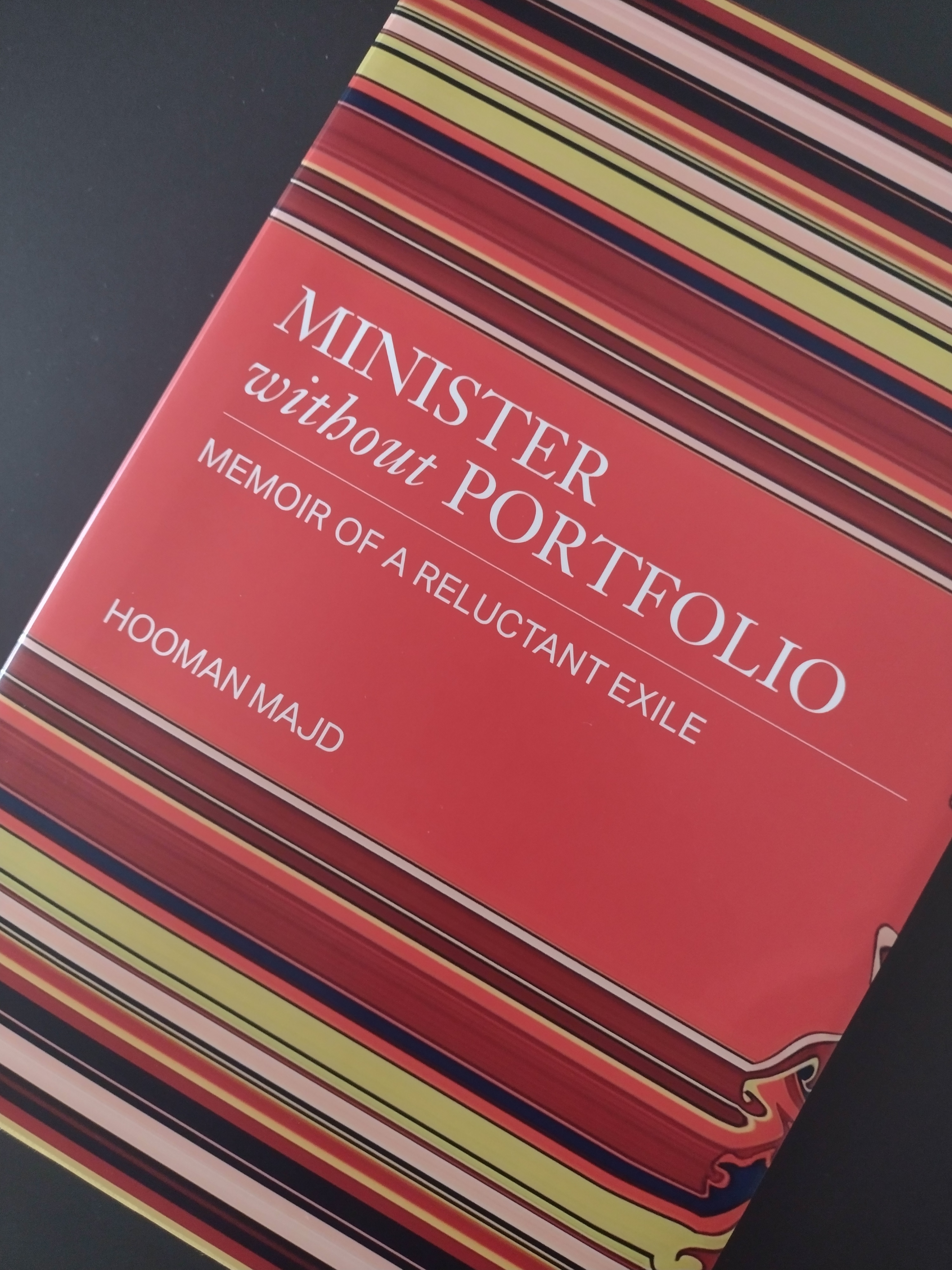
Hooman Majd has got a questionable reputation during the so-called Green Movement in Iran, brutally crushed by the regime (similar to what had happened only a couple of weeks ago), when the election of 2009 in Iran was probably rigged and Iran’s firebrand President Mahmoud Ahmadinejad was “re-elected” for a second term. Author and journalist Majd, frequently writing for mainly US media outlets, was, in particular for the Iranian diaspora, way too apologetic of the regime.
Anyway, I’ve read his two books, The Ayatollahs’ Democracy of 2008, and The Ayatollah Begs to Differ of 2010 with great interest and, well, admiration. I have written about them here and here.
Without doubt, Majd has had an interesting life in the West and East. So, I anticipated his memoir which appeared end of last year, Minister Without Portfolio – Memoir of a Reluctant Exile.
But having finished it, I have to admit that I was wondering who was actually to be addressed, who should read that memoir? The mainly two parts of his book describe his life in the music business as, well, his boss’s, Chris Blackwell’s, minister without portfolio at Island Records and its numerous offshoots in 50 years or so; as well as his second career as author and journalist in and about Iran under the presidents Mohammad Khatami (Majd’s relative by marriage) and Mahmoud Ahmadinejad. I have written about Ahmadinejad’s biography of 2008 by Kasra Naji here.
Unfortunately, reading Majd’s memoir requires to be familiar with both worlds, that in music business and Iran. But I’m afraid that, apart from the majority or at least some of the artists who Island and its later owners produced, few people would even know any of the mentioned members of the groups or even get an idea of what Majd’s constant name-dropping of people he met, had lunch with, forged a contract, attended a concert with (in the Caribbean, especially GoldenEye on Jamaica which was owned by his boss, Blackwell; California, New York, London, and so on) would finally mean. Bad, the book doesn’t have an index. (As a note, I have checked my around 500 vinyl albums from the late 1970s and late 1980s and was surprised how many have actually been published by the larger Island Universe.)
The founder of Island Records, Chris Blackwell, wrote his own memoir in 2022 (which I haven’t read yet), and Majd mentions that fact when describing that the two finally fell out and he was fired from his job in 1999.
“I knew Chris well enough by then, and when he decided to part with someone, or fall out with someone, that was that. Chris’s character hadn’t changed; my mistake had simply been believing that I would, because of the friendship – and especially the time with him and Mary when she was sick – be immune from his falling out with me. I was to leave Palm, he said, at the end of the year – a couple of weeks away – and stay on top of Norrington’s film until it was complete, for which I could be paid. I walked away from lunch in shock. I had been working for Chris for more than a decade, and we had become like family. But family, I learned then and again later, didn’t protect you from Chris’s moods and his inability to accept blame for his own actions. Now I had no idea what could come next.”
Blackwell’s memoir does have an index, and Majd, claiming to have been “part of the family”, is not even mentioned. Blackwell’s grudge was running deep, apparently. Majd’s own memoir may be a response to being overlooked by his former boss, focusing on the same, highly exclusive, and colorful inner circle of Blackwell’s.
It was a precarious time for Majd after they broke, fore sure (they soon reconciled later, though). He was even a couple of years unemployed when not really knowing what to do.
I have to admit that I was much more interested in Hooman Majd’s description of his “homecoming”, i.e., when, in 2004, he finally decided to visit Iran for the first time after the Islamic Revolution. I found it stunning that Majd returned around the same time when I had started my numerous visits to Iran after having moved to the Middle East in 2001. It was President Khatami’s second term, a so-called reformer, the friendly face of the regime.
The hostile relationship between the US and Iran since the hostage crisis of 1979/80 seemed to normalise in one way, while Iran’s clandestine nuclear program in violation of the Nuclear Non-proliferation Treaty became a major concern for the West.
Mohammad Khatami’s brother Ali is married to one of Majd’s cousins, so the familiar bonds are rather weak. However, Iranians are masters in networking. Former President Khatami gave Majd an interview which was published in GQ magazine (a “sexy” magazine, as Majd is eager to mention), and later, Majd was Khatami’s interpreter when he visited the United States in 2006.
An interpreter he also was for Iran’s next President, Mahmoud Ahmadinejad. And especially the cartoon in the New York Observer is funny showing the firebrand at the UN as well as sweating blood and tears interpreter Majd.
The much more interesting second part of Majd’s book shows that he had really been homecoming when in Iran, including growing a beard.
Believe it or not, when traveling in Iran, I sometimes felt the same. I even became apologetic for the regime myself, see, for example, the blog’s title and manifesto and somewhat effusive posts on another blog of mine. (Note that the featured river, in this particular link, the famous Zayandeh Rud, has dried out in the meantime.) I had interpreted this a homecoming of my soul, connecting with the people, the millennia of history, the art and culture. What the regime has done to the ordinary people, however, is not easy to fathom.
Back to Hooman Majd. In April 2009, six weeks before the election, he was in Iran and reported for NBC News. Majd claims that he was an outspoken supporter of the Green Movement of presidential candidate Mir-Hossein Mousavi. The election was on 12 June 2009, the results were probably rigged and Ahmadinejad was declared, by the Supreme Leader Ali Khamenei, the winner. In 2026, Mousavi seems to be still under house arrest after he supported uprisings during the so-called Arab spring in 2011.
As he mentioned in passing, Majd was even wearing, in US American television shows, green Persian shoes (as clear sign for supporting the Green Movement) but was perceived way to apologetic for the regime (as he later published his second book, The Ayatollahs’ Democracy, read my review here).
At least I considered him then as almost on a line with notorious U.S. Professors Flynt Leverett and his wife Hillary Mann Leverett and their close friend Eric A. Brill, a useful idiot for the regime. Not so much the Iranian chief propagandist Syed Mohammad Marandi, of course.
Majd took his family (he had married his long-time girlfriend and the couple had got a baby boy) in 2011 and stayed, for a period of 10 months in Tehran. For another book project, they wanted to figure out how it is to live in the Islamic Republic, a Shia State. The mere fact that the regime allowed him to settle for that long indicates that his claimed support for the brutally cracked down opposition went at least unnoticed.
During December 2008 and early January 2009 (i.e., way before the contested election and subsequent riots) I was several weeks in Esfahan and Nain. At that time, I was indeed thinking of whether settling for longer in the country I loved very much would have been possible. I came to the conclusion, rather not, for similar reasons Majd is outlining in his memoir. I never flew to Iran again. There is long a travel warning issued by our Foreign Ministry.
The final chapters of Hooman Majd’s biography deal with his accompanying reporting on the negotiations of the five members of the UN Security Council plus Germany (P5+1) and Iran about Iran’s nuclear program.
What was finally achieved, in 2015, the Joint Comprehensive Plan of Action, or JCPOA (still a non-legally binding agreement, a voluntary political commitment which was never ratified by any nation; a so-called political understanding), was a milestone and big success for the second Obama administration.
Three years later an apparently functioning deal was shredded into pieces by President Donald Trump, Obama’s successor in the White House, who withdrew from the agreement, and Iran began again enriching uranium.
At one point of the JCPOA negotiations Majd was warned not to fly to Tehran again if not wanting to end in Evin prison as other Americans with dual citizenship. In concluding his memoir, he mourns the present status of homelessness.
“…I’ve never really known what home is. I thought I was looking for one when I applied for and received my Iranian passport, and that perhaps I had found it when I first traveled there as an adult in 2004. But I know that home is more than a geographical location. My mother and father had homes – my father hating his and happy in his escape, my mother longing for hers and dying without seeing it again – but I don’t. I know that for my sister England is home, and I suspect my brother simply doesn’t mind no having one. But for me, if I could relish being a minister without portfolio throughout my career, I can also accept that home will remain an unknown concept, and that that’s just the way it is, and always will be.”
19 February 2026 @ 15:45 UTC+1.
Last modified February 19, 2026.
 Freelance
You must be logged in to post a comment.