Die Gedanken sind frei

Well, still. With new progressive developments such as Google Glass users may surrender to total surveillance soon, given the disturbing news that Google and the NSA seem to be more or less one and the same. And the NSA is right now working on remarkable capabilities, see here. Will freedom of thought will ultimately vanish? Maybe not so fast.

A nice homage to Norman Finkelstein anyway.

2 July 2013 @ 3:43 pm.

Last modified July 2, 2013.

Posted in surveillance | Tagged , , , , | Leave a comment

As Odd as it May Sound

Update below. Update II

“There is one condition if he wants to remain here: he must stop his work aimed at damaging our American partners. As odd as it may sound from me,” Vladimir Putin told journalists at a media conference in Moskow when offering Edward Snowden asylum in Russia.

Snowden deserves better. Jürgen Trittin, chairman of Germany’s Green Party’s parliamentary group, had demanded in German TV morning show that a European country and, after having been asked specifically, in particular Germany, should grant asylum rather than Russia, China or Ecuador.

For several weeks, Snowden’s leaks have increased public awareness of the looming surveillance state in the so-called free world. This has widely been seen as a narrow window of opportunity, a final wake-up call. We all got a last chance to stop cancerous surveillance of anything and everybody.

Snowden has made very clear that he never intended to damage “the Americans.” He could have contacted Chinese security services or the FSB (the successor of KGB) directly. He could have made lots of money. He didn’t. So far, his noble intentions are absolutely trustworthy.

Anyway, it seems that he has leaked already all what he has. It’s by the media what will be published next.

1 July 2013 @ 4:59 pm.

Update @ 6:46 pm.

Meanwhile, Snowden has applied for asylum in 15 countries including Russia, hours after Russian President Vladimir Putin had granted him political asylum provided he won’t damage American partners anymore.

Update II, July 2, 2013.

As the WikiLeaks site knows, Edward Snowden has applied for asylum in at least 21 countries so far including Germany and Norway.

Posted in Russia, USA | Tagged , , , , | Leave a comment

Friendly Leaks

Reports on Friday that ex-Pentagon General James Cartwright is subject of a DoJ investigation into last year’s Stuxnet leak to the New York Times may be a red herring. It is one of the stories which in general would shine light on President Barack Obama’s strategies, sabotage of Iran’s, as far as we know, peaceful nuclear program. Before David Sanger reported exactly one year ago that it was Obama’s order which sped up the cyber attack on Iran, which had originally been hatched by his predecessor George W. Bush under the code name Olympic Games,  there was lots of speculation about Israel as origin of the computer worm Stuxnet (a file name inside the code contained “Myrtus”, which might have something to do with the Book of Esther, who was a Hadassah, Hebrew for myrtle, see here). Now it had turned out that it had been a joint venture.

With high confidence, James “Hoss” Cartwright has nothing to fear. These kinds of leaks are actually too favorable for the Nobel Peace Prize awardee. It had been suggested one year ago that the leaks about Obama’s cyber and drone wars and his personal kill list may have been most welcome in his reelection campaign. Of course, in the long run people won’t forget so easily and “friendly leaks” will sooner or later backfire.

Remains the question why Cartwright has been targeted right now. Well, relentless prosecution of whistle-blowers and now even those reporters who make a story out of the stuff has a prize. But the retired general will be treated in a completely different way. Maybe we won’t hear anything of the story anymore.

30 June 2013 @ 4:17 pm.

Last modified June 30, 2013.

Posted in USA | Tagged , , , , , , , | Leave a comment

A Real Journalist

“A real journalist is one who understands, at a cellular level, and doesn’t shy away from, the adversarial relationship between government and press.”

That’s what the New York Times’ Public Editor Margaret Sullivan has suggested yesterday when commenting on almost an avalanche of more or less disparaging claims and, well, smears as regards “blogger” and “columnist” Glenn Greenwald, the intermediary who provided The Guardian United States with Edward Snowden’s leaks of the apparent American surveillance state.

This is of course not a definition but a very broad description, and tenuous position. The main issue here is, now more than ever, whether and when someone who makes leaks public may be legally protected by law when having promised confidentiality to his or her sources. Does one need to be employed by a magazine (“journal”) to become a journalist? Has someone even to join the mainstream media (MSM)? Of course not. Interestingly, the somewhat broader German term “Publizist” (uncommon “publicist”) would fit better since it implies more or less independence in writing. But who is it who then publicizes the stuff? Was it protection by the honorable Guardian what Greenwald sought in the first place?

Greenwald had left the small news website Salon.com, where he was “blogging” since 2007, only in August last year. Some had then serious concerns that his fearless and razor-sharp postings on civil liberty would inevitably be tempered by The Guardian’s editors. Why did he move on to MSM? What did The Guardian expect from his rants? As Greenwald had twittered earlier this month, he was contacted by Edward Snowden only a couple of months later, at least in February 2013, when Snowden was still in Hawaii.

So, one might assume that, between February and June, both had effectively teamed up. Questions about Greenwald’s part in Snowden’s leaks (as brazenly asked by NBC’s David Gregory in Meet the Press last week) may thus be justified. But Greenwald’s aspiration to get the scoop might put the whole noble enterprise at risk. As do pretty bizarre involvements of Julian Assange and Wikileaks and the Ecuadorian embassies. It might end up as a charade. And, as MSM continue their reporting on kraken-like NSA, Snowden’s fate is completely uncertain.

See Greenwald’s speech delivered yesterday, via skype, to the Socialism 2013 Conference in Chicago.

30 June 2013 @ 9:42 am.

Last modified June 30, 2013.

Posted in surveillance, USA | Tagged , , , , , | 2 Comments

A Frenzy State of Emergency

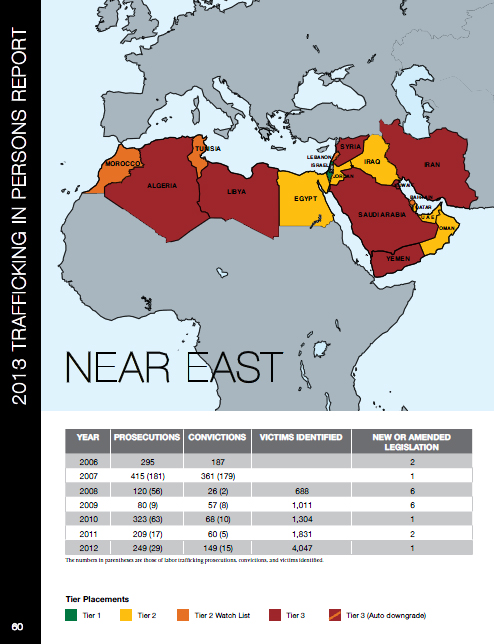
U.S. State Department’s 2013 Trafficking in Persons Report 2013 [pdf] points to the shameful situation of forced labor, including nonpayment of wages, long working hours without rest, deprivation of food, and threats; as well as physical and, in particular, sexual abuse, and restrictions of movement in, well, all countries of the Middle East. Kuwait, for example, has been placed on Tier 3 for the 7th consecutive year (after tier 2, watch list in 2006). Countries placed on Tier 3 are those whose governments do not fully comply with the Trafficking Victims Protection Act’s (TVPA) minimum standards and are not making significant efforts to do so. 

TIER 1
Countries whose governments fully comply with the Trafficking Victims Protection Act’s (TVPA) minimum standards.

TIER 2
Countries whose governments do not fully comply with the TVPA’s minimum standards, but are making significant efforts to bring themselves into compliance with those standards.

TIER 2 WATCH LIST
Countries whose governments do not fully comply with the TVPA’s minimum standards, but are making significant efforts to bring themselves into compliance with those standards AND: a) The absolute number of victims of severe forms of trafficking is very significant or is significantly increasing; b) There is a failure to provide evidence of increasing efforts to combat severe forms of
trafficking in persons from the previous year; or c) The determination that a country is making signif icant ef for ts to bring itself into
compliance with minimum standards was based on commitments by the country to take additional future steps over the next year.

TIER 3
Countries whose governments do not fully comply with the minimum standards and are not making significant efforts to do so.

“Governments of countries on Tier 3 may be subject to certain sanctions, whereby the U.S. government may withhold or withdraw nonhumanitarian, non-trade-related foreign assistance. In addition, countries on Tier 3 may not receive funding for government employees’ participation in educational and cultural exchange programs. Consistent with the TVPA, governments subject to sanctions would also face U.S. opposition to assistance (except for humanitarian, trade-related, and certain development-related assistance) from international financial institutions such as the International Monetary Fund and the World Bank.

“No tier ranking is permanent. Each country, including the United States, can do more. All countries must maintain and increase efforts to combat trafficking.”

Trafficking in Persons Report 2013

See the detailed reports here. Kuwait, Saudi Arabia, Yemen, Syria and Iran all were ranked tier 3. The Emirates, Oman, and Qatar were placed on tier 2. As regards Kuwait,

“Many of the migrant workers arriving for work in Kuwait have paid exorbitant fees to recruiters in their home countries or are coerced into paying labor broker fees in Kuwait that, by Kuwaiti law, should be paid by the employer—a practice that makes workers highly vulnerable to forced labor, including debt bondage, once in Kuwait. The media reported that Kuwaiti employers brought unskilled workers into Kuwait on “commercial” visas without providing them with work permits; this left workers unprotected under labor regulations and vulnerable to abuse, including conditions of forced labor. Kuwait’s sponsorship law restricts workers’ movements and penalizes them for “running away” from abusive workplaces; as a result, domestic workers are particularly vulnerable to forced labor inside private homes. In addition, media sources report that runaway domestic workers fall prey to forced prostitution by agents or criminals who exploit their illegal status.

“During the reporting period, the government did not report any arrests, prosecutions, convictions, or sentences of traffickers for either forced labor or sex trafficking. Although the withholding of workers’ passports is prohibited under Kuwaiti law, this practice remains common among sponsors and employers of foreign workers, and the government demonstrated no genuine efforts to enforce this prohibition. Almost none of the domestic workers who took refuge in their homecountry embassy shelters had passports in their possession. The government remained reluctant to prosecute Kuwaiti citizens for trafficking offenses. When Kuwaiti nationals were investigated for trafficking offenses, they tended to receive less scrutiny than foreigners. Kuwaiti law enforcement generally treated cases of forced labor as administrative labor infractions, for which punishment was limited to assessing fines, shutting down employment firms, issuing orders for employers to return withheld passports, or requiring employers to pay back-wages. The government did not conduct anti-trafficking trainings for government officials during the reporting period.”
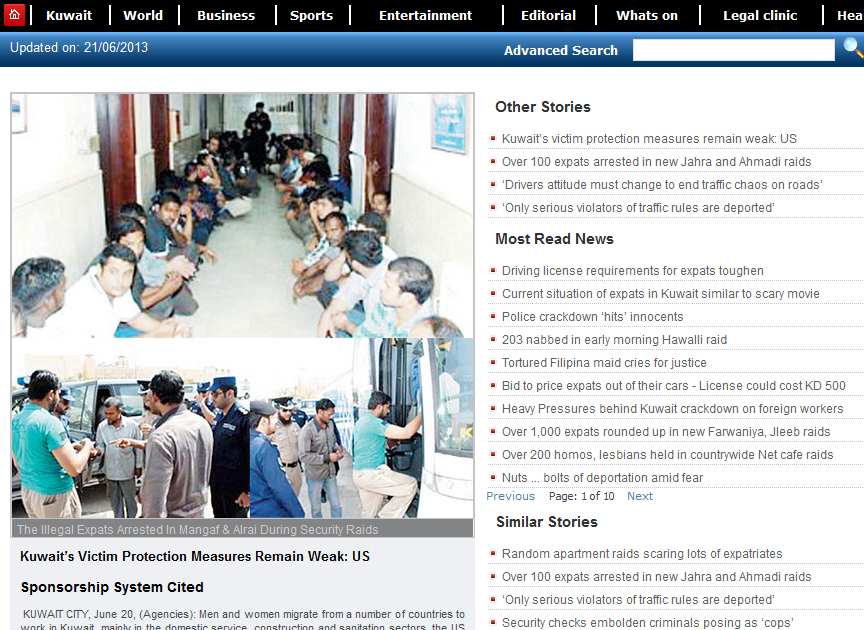
Arab Times 21 June,2013

Kuwait’s English-language tabloid Arab Times at least reports on the shameful fact. A closer look at the newspaper’s page containing the main article reveals what’s up in the country otherwise. There seems to be a frenzy state of emergency in one of the richest autocracies in the world, one of the strongest allies of the United States. And, what amazes more, it is South Asian workforce which is mainly targeted. By raids, crackdowns, torture, deportation. Raids on “homos” and lesbians.

As one headline tells, the “[c]urrent situation of expats in Kuwait [is] similar to [a] scary movie.”

21 June 2013 @ 1:10 pm.

Last modified June 21, 2013

Posted in Kuwait, Middle East | Tagged , , , | 1 Comment