Agitated John Kerry Tells Snowden “Man Up!”

Edward Snowden’s interview with NBC’s anchor Brian Williams in Moskow last week, which was aired last night, yielded some news. In particular that Snowden has emailed his concerns to colleagues and superiors at the National Security Agency before he leaked them to Glenn Greenwald and Laura Poitras. He was told, “You should stop asking questions”. Similar statements have been made by Chelsea Manning when she was in Iraq. And before leaking the Afghanistan and Iraq war logs, the diplomatic cables, the Collateral Murder video etc. to Wikileaks, she had tried, according to her account, to get mainstream media interested. As the Washington Post reports, in Snowden’s case, at least two U.S. officials have confirmed on Wednesday that Snowden has actually sent at least one email to the NSA’s office of general counsel raising policy and legal questions.

An apparently agitated Secretary of State John Kerry exhorted Snowden on CBS This Morning already on Wednesday to “man up” and stand trial in the U.S. Fatherly patronizing Snowden is the latest turn in explaining the public why on hell someone wants to expose the mass surveillance state the U.S. has become in particular after 9-11 if not for the lowest motives.

But dont worry too much. As the Washington Post knows, U.S. politicians have frequently been admonished to “man up” in recent years. President Obama himself was challenged, among other occasions, by an Mitt Romney aide in the 2012 Republican election campaign to “man up” and use force in the Libya debacle. It seems to be a popular way to belittle an adversary. Ben Zimmer has a few explanantions of the phrase’s meaning, the most obvious being “Don’t be sissy”. Well, after all we know one year after his leak, sissy is the last attribute I would assign to Ed Snowden.

29 May 2014 @ 5:10 pm.
Last modified May 29, 2014.


Posted in surveillance, USA | Tagged , , , , | Leave a comment

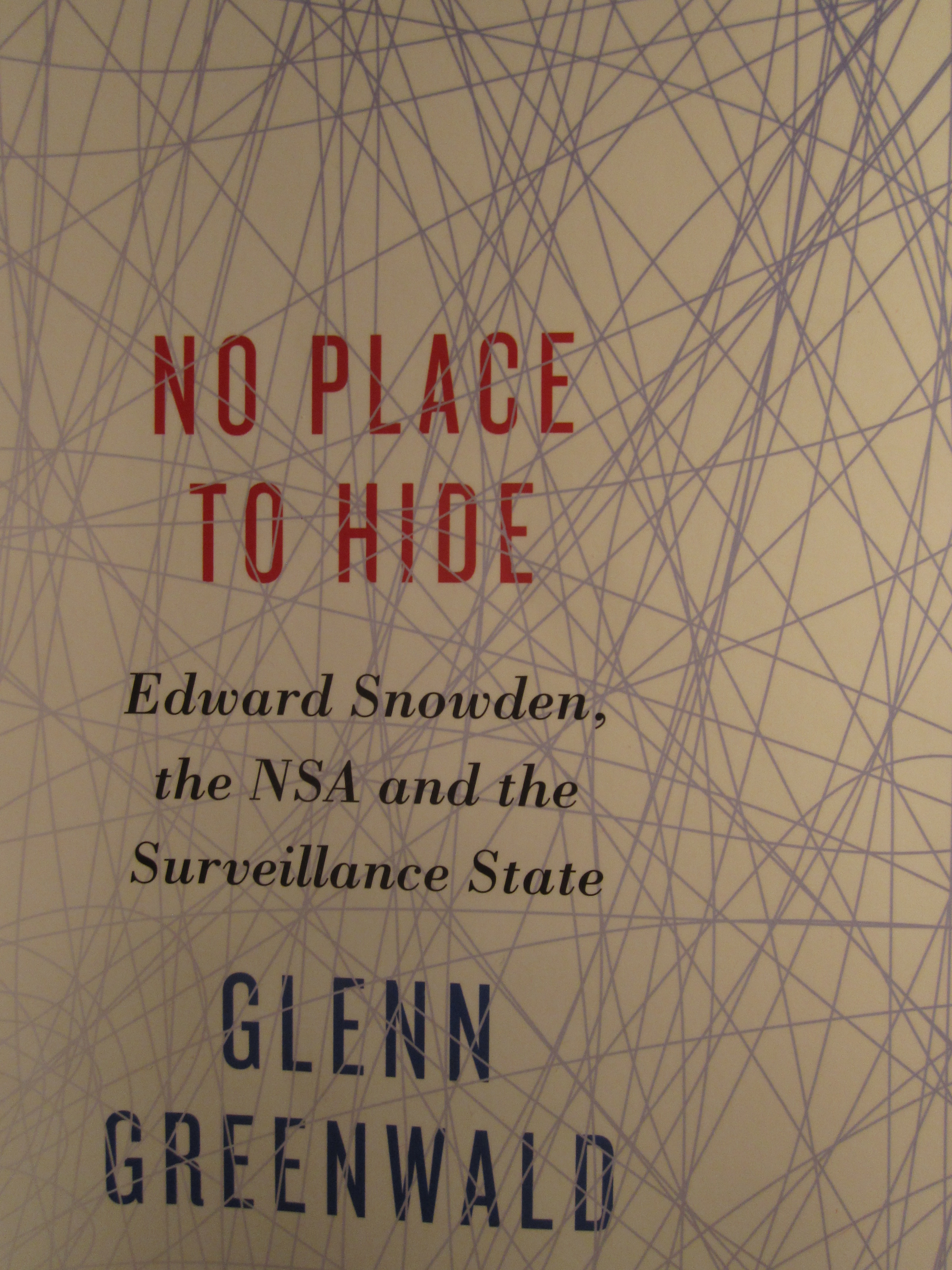
No Place To Hide

IMG_0231At the outset of his new book, Glenn Greenwald quotes Senator Frank Church’s 1975 statement, who was critically assessing intelligence activities in the U.S.,

“The United States government has perfected a technological capability that enables us to monitor the message that go through the air. …That capability at any time could be turned around on the American people, and no American would have any privacy left, such is the capability to monitor everything – telephone conversations, telegrams, it doesn’t matter. There would be no place to hide.”

What Edward Snowden has revealed last year in Hong Kong and what Glenn Greenwald and Laura Poitras had amplified in relentless articles since, first in the Guardian, then in a new, but still largely under construction, enterprise co-founded by Greenwald, The Intercept, and, to a lesser extent the Washington Post and other media outlets such as Germany’s Der Spiegel, proves that it has turned meanwhile against Americans and, more important, all of us. Benthem’s Panopticon is, it seems, reality. And regardless of whether the U.S. has developed into a totalitarian state (there are strong indications; to list a few, its claim to rightfully and authoritarian act as a single superpower, the endless war on an ill-defined concept such as terrorism, relentless persecution of whistle-blowers, even journalists, despite claiming otherwise, a global assissination campaign targeting even “radical” American citizens; all in the aftermath of the 9-11 attacks on U.S. soil) Orwell’s worst apprehensions have undoubtedly become true. I vividly remember, when having seen Tony Scott’s Enemy of the State of 1998, that I had considered NSA officers’ wrongdoings as absurd exaggeration. But was is done right now is exactly what is decribed in the movie. Or worse.

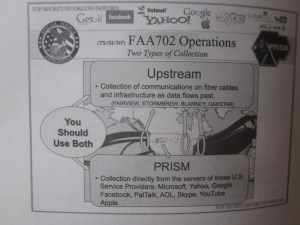
Greenwald’s book begins as a spy thriller, and it is said that this part will probably serve as screenplay for a Hollywood movie. There is drama in Greenwald’s and Poitras’ journey to Hong Kong but Greenwald hyperbolizes. His outright beatification of Edward Snowden is not very credible. Snowden might indeed be an idealist. But what is missing in Greenwald’s narrative is complete lack of any desperation of somebody who has decided to live as state enemy in hiding forever. That Greenwald did not identify the ominous “Cincinnatus” as “the source” in the first place even after he had got to know Snowden in person is not credible either. Greenwald continues with the malicious obsession of mainly former head of the NSA, General Keith Alexander, to “collect it all” and how he and his buddies are going to do that while severely violating the U.S. Constitution’s Fourth Amendment. I was wondering to what kind of audience the numerous, sometimes gawkish, power point slides were shown, who was to be convinced or trained (specifially in what?) or bored in lenghty lectures. All Noforn and Top secret, of course. IMG_0229“You Should Use Both” (Upstream and PRISM) sounds like a well-intentioned tip of an elementary school teacher. For what purpose? Apparently (and embarrassingly), NSA total surveillance has not prevented a single terrorist assault. Let alone criminal acts. That’s what I actually would expect first. Greenwald continues with some philosophical and probably rather superfluous excursion on why total surveillance is deleterious for any vital democracy. That is something here in Europe is known since Nazi and Stalin terror regimes and DDR Stasi. Greenwald is probably right that attempts by NSA and its British counterpart GCHQ to “sniff it all” and “collect it all” must not be regarded harmless given the complete ineffectiveness to prevent terror and crimes. Prevention of terror is thus not the main motive, just a pretext. It is hoped that, in the medium run, any United States government cannot afford to spy on its citizens. On the other hand, U.S. citizens seem to be rather apathetically when it comes to government wrongdoings. What is also of concern is outright appeasement of strong allies such as the German government which seems to be unwilling to show the Obama administration its limits, for instance by granting Edward Snowden asylum. Greenwald continues with his, sad to say, rather justified revile of mainstream media which, with anticipatory obediency, have rather fired the gun at the messenger (Snowden and Greenwald) instead of the NSA. And which no longer are basically adversarial to governments, which is vital for any democracy. The Fourth Estate. Endnotes and and index have been omitted from the text, they can only be found online, just 30 pages which should have been included in the book.

20 May 2014 @ 8:42 pm.
Last modified May 20, 2014.
Posted in Book Review, USA | Tagged , , , , | Leave a comment

Problems With Data

General Keith Alexander, retired head of the U.S. American mass surveillance spy organization NSA is trying hard to polish the battered public image of his former agency. He was recently mocked in John Oliver’s debut show Last Week Tonight where he apparently had not been informed beforehand that that was just a joke. But now, he had cautiosly selected an “interviewer” who gave him a great platform for some PR, in Australia. As tired (after all celebrations after winning the Polk Award for Journalism, the Pulitzer Prize for his former employer, The Guardian, the Munk Debate with Michael Hayden and Alan Dershowitz, and lengthy propaganda pieces with Keith Alexander) Glenn Greenwald notes, the “interviewer” of the Australian Financial Review is another “model of uncritical stenography journalism.”

Greenwald points to the fact that, when asked, how many documents former NSA contractor Edward Snowden had stolen, Alexander answered “I don’t think anybody really knows what he actually took with him. […] What we do have an accurate way of counting is what he touched, what he may have downloaded, and that was more than a million documents.” Quite different from the reported 1.7 million “stolen” documents claimed back in December. In other words, Alexander doesn’t know.

I have found another inaccuracy of data and a strange way of pointing at terroristic threats.

“AFR [the interviewer]: How has the rate of change in the frequency of serious threats to which the West is exposed evolved over the last 2-3 decades? Has the diversity and sophistication of threats altered much, or is it just more of the same with a new technical delivery device in the form of the Internet and the technologies it has enabled?

Gen. Alexander: Well I think the frequency of the threats we face is absolutely changing, especially on the terrorism front.

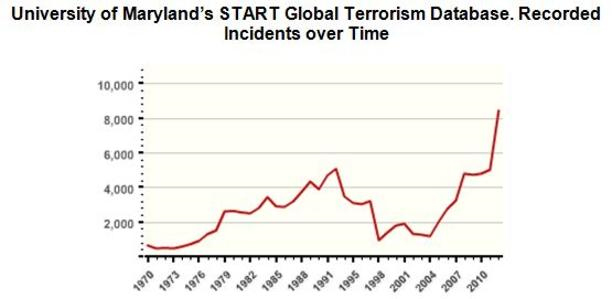
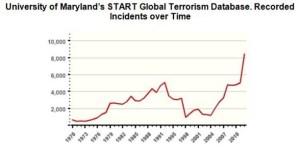
Let me offer you some data that I got from the University of Maryland’s START [National Consortium for the Study of Terrorism and Responses to Terrorism] program’s Global Terrorism Database [refers also to chart].
START

I think this is chilling. People like Bart Gellman [an American journalist] say NSA is ‘hyping the threat’ to justify what we do, but let me just give you the facts, which the University of Maryland’s START program provides to the government and which the State Department includes in its annual Country Reports on Terrorism. In 2012, they said there were 6,771 terrorist attacks worldwide, resulting in over 11,000 deaths with over 2,436 in Iraq alone. In 2013, that grew to 10,301 terrorist attacks, resulting in 20,641 deaths, 7,000 of which were in Iraq.

So when you look at what’s going on in Iraq, what’s happening in Syria, the instability in Egypt and other regions, my objective judgement is that national security hazards are expanding at an alarming rate. And this is supported by the data.

If you reflect on that instability in, for example, the Middle East, I am concerned that individuals and/or nations will miscalculate and something bad will happen as a result.”

Well, data provided by the Country Reports on Terrorism of the University of Maryland (START) differ.

“The 2013 statistical annex documents 9,707 attacks worldwide. These attacks resulted in more than 17,800 deaths and 32,500 injuries. In addition, more than 2,990 people were kidnapped or taken hostage. On average there were 808.91 attacks per month and 1.84 fatalities and 3.36 injuries per attack, including perpetrator casualties.

According to the annex, the 10 countries that experienced the most terrorist attacks in 2013 are the same as those that experience the most terrorist attacks in 2012.

Although terrorist attacks occurred in 93 different countries, they were heavily concentrated geographically. More than half of all attacks (57%), fatalities (66%), and injuries (73%) occurred in Iraq, Pakistan and Afghanistan. By wide margin, the highest number of fatalities (6,378), attacks (2,495) and injuries (14,956) took place in Iraq. The average lethality of attacks in Iraq was 40 percent higher than the global average and 33 percent higher than the 2012 average in Iraq.

As regards worldwide attacks in 2013, the START reports much lower and not so precise numbers of fatalities as Alexander’s claim (“more than 17,800 deaths” as compared to “20,641 deaths”). In Iraq, START mentions 6,378 fatalities, Alexander rounds this up to 7000. Anyway, it is Iraq, Afghanistan and Pakistan where most “terroristic attacks” happened, not only in 2013 but since the U.S. is at war with these countries. In what world does Keith Alexander live? Has he ever heard about Isaak Newton’s third law of motion, “When one body exerts a force on a second body, the second body simultaneously exerts a force equal in magnitude and opposite in direction on the first body.” Probably not.

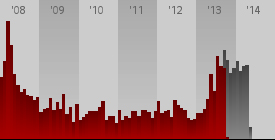
What happens every day in Iraq may be assessed by having a look at the Iraq Body Count site. Since the AFR “interviewer” does not interfere, does Alexander think that we believe his alleged concern about terror in Iraq?
IBC

8 May 2014 @ 8:29 pm.
Last modified May 10, 2014.


Posted in surveillance, USA | Tagged , , , , , , , , | 1 Comment

Almost a Significant Emotional Event (After 9-11)

Unknown

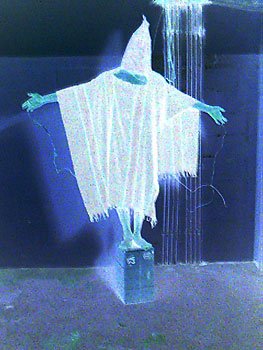
Thanks to Democracy Now!. Last week, pictures were broadcast by CBS which shocked the world. I still consider them one of the Significant Emotional Events* in my whole life. I have written about my whereabouts on that very day five years ago, and today I feel much grief.

Where had I been then? Well, I was a tourist visiting Damascus, Syria. I have actually written about the trip five years ago. Here is a brief excerpt. Pictures of Damascus in 2004 can be seen here.

Almost a Significant Emotional Event

Where had I been in late April 2004? I remember (as an almost significant emotional event) an afternoon in Damascus. I had invited an Iraqi Professor of Geophysics to my room in the Cham Hotel. I was a tourist, and he had just brought his family with the car from Holland, where he worked, to Baghdad. Right now, he was on his way back to Amsterdam in order to quit his job and then permanently move to Iraq. He had some hope of getting a position at Baghdad University. The stopover in Damascus provided him with the opportunity of visiting some of Islam’s holiest places.

Dr. Saad had noticed me when entering the Umayyad Mosque, one of the most awesome buildings in the Islamic world. It was my first visit of a mosque ever, and I had been stumbling into the smooth as glass-like courtyard, when I suddenly heard his warning: “Better remove your shoes!” With an apology I did, and when I entered the gorgeous prayer hall itself, I met him again.

We chatted, about Kuwait, Iraq, Holland, Germany. Besides tourists, many families with their children were visiting the mosque. Adults were talking and kids playing. Some people prayed in groups, others alone. The stained glass windows, allowing streams of sunlight coming in, almost reminded me of a church. In fact, this is the haram for St. John the Baptist’s shrine (now one of the prophets of Islam), which can be visited in a prominent place in the mosque. During the period of 706 through 715 CE, the Umayyad Caliph Al-Walid I reconstructed (rather than demolished) the once Christian church into one of Islam’s most significant mosques. But one minaret still reminds one more of a church tower. Pope John Paul II had visited the site in 2001.

Dr. Saad, who hasn’t been in Damascus either, suggested that we can learn more about the city when strolling together through the streets. After we had left the Umayyad Mosque, we visited the Holy Shrine of Imam Husayn’s little daughter Ruqaiyyah, and I saw the plenty of toys in her grilled little tomb. The next day, Friday, we went to Lady Zaynab’s shrine in the vicinity of Damascus, a sister of Husayn who had survived the Battle at Karbala in the 7th century. For the first time, I participated, as a calm observer, in the Friday prayers.

Back in the hotel, we switched-on the TV and suddenly, he asked the most disturbing question: “Do you understand what you see there?” I didn’t. It was a report on an incredible crime in, one has to call it, a dungeon in Baghdad, called Abu Ghuraib. Only days later, when back in Kuwait, I began to realize what was soon considered the day, when G. W. Bush lost the war in Iraq. It was almost a significant emotional event, one which you never forget in your life. Dr. Saad and I went also to the Anti-Lebanon Range and to small villages where rich Syrians (and also rich Kuwaitis) keep their chalets as summer getaways.

[…]

What has happened to the Iraqi Professor? He has moved his family back to Holland. A life in Baghdad is no longer possible, he recently told me on the telephone. Alhamdulillah, he has now got a position at Delft University.

* A Significant Emotional Event (SEE) is an experience (or experiences) that creates an emotional meaning which affects us in later life. Examples may be 9/11, the assassination of JFK, the sudden loss of loved ones, maybe a cancer diagnosis.
 
5 May 2014 @ 6:20 pm.
Last modified May 5, 2014.
Posted in Iraq, Syria, USA | Tagged , , , , , | Leave a comment

Condi Caught Up By the Past

US-BUSH

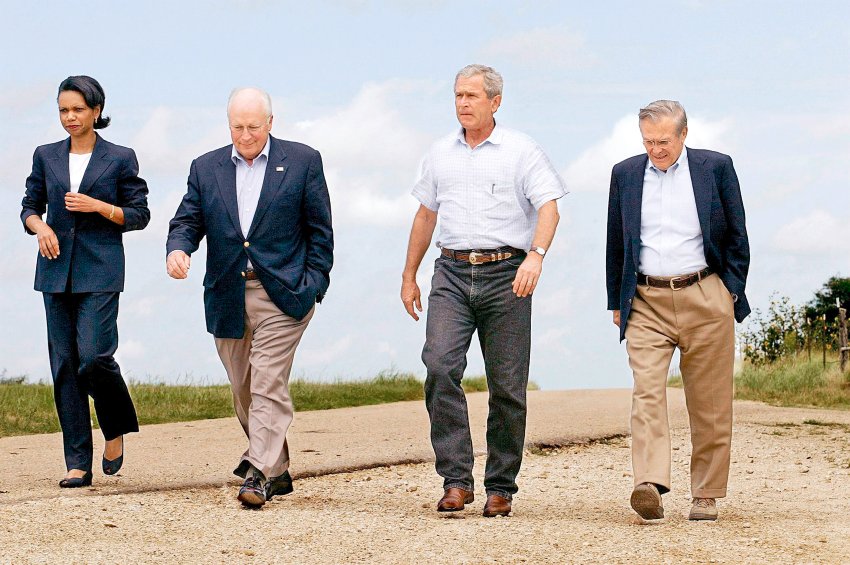
Former key figures of G.W. Bush’s administration are well advised to carefully take possible so far unatoned war crimes into account when going public. Condoleezza Rice had apparently noticed that it simply would not be possible to give her commencement speach at New Jersey’s Rutgers University (including a $35,000 honorarium) as planned. Students and professors, who would like to question her contributions in the Iraq war disaster and her role in authorizing torture techniques (“enhanced interrogation techniques”) at Guantanamo, in Afghanistan and Abu Ghraib in Iraq, would certainly heckle.

Condoleezza Rice is Professor of Political Economy in the Graduate School of Business at Stanford University. She certainly knows what commencement, or graduation ceremony, means to students. Thus, she just cancelled her appearance although University Professor Robert Barchi did not rescind the invitation.

4 May 2014 @ 5:17 pm.
Last modified May 4, 2014.
Posted in Academics, USA | Tagged , , , , , , | Leave a comment