
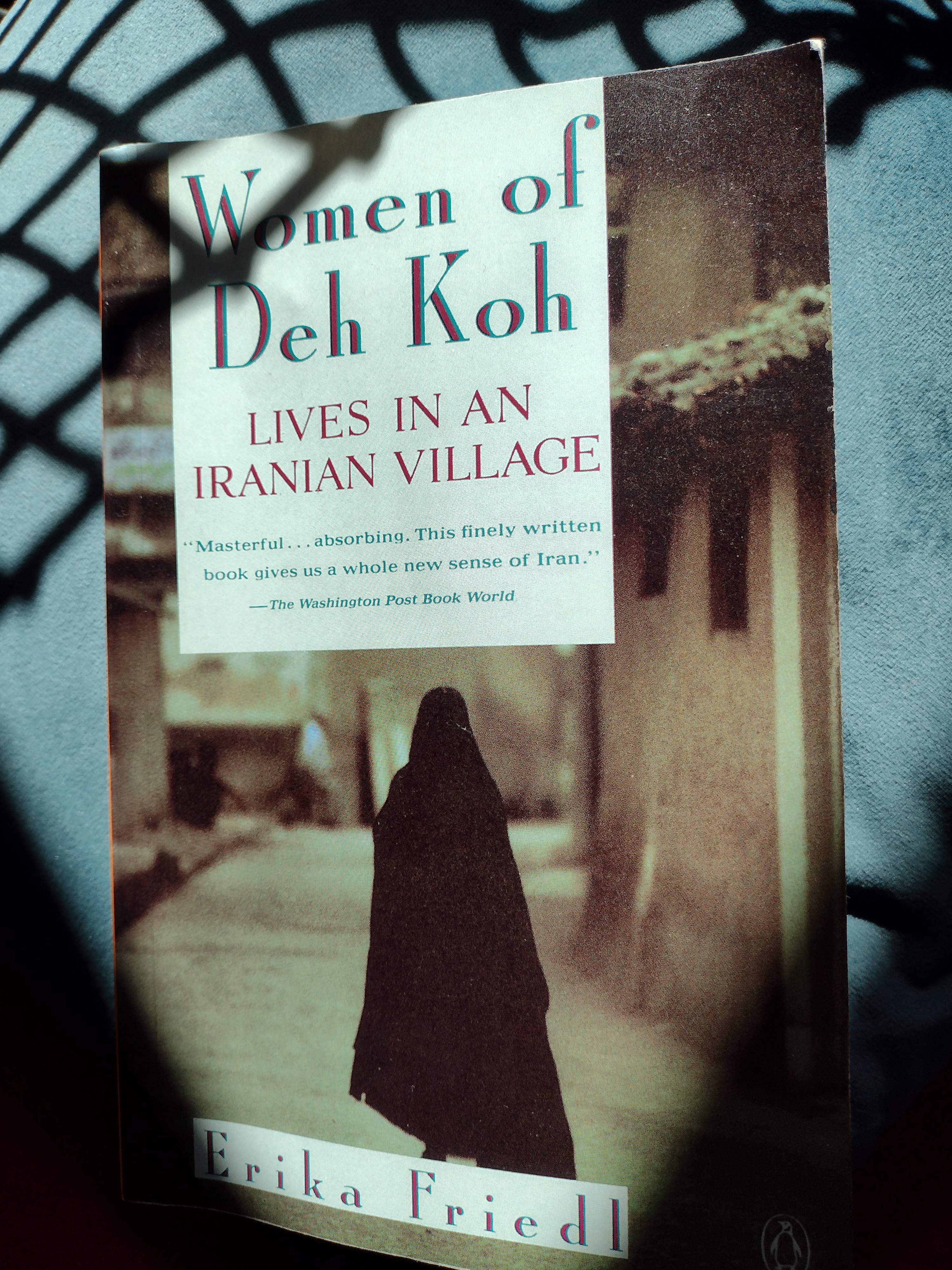
Can the lives of people in Iranian villages in the late 1970s and 1980s be compared with what ordinary people in rural Iran experience these days?
I have come across the work of ethnographers/anthropologists Erika Friedl and her husband’s Reinhold Loeffler, both retired Professors at Western Michigan University, when the latter’s book of 1988, Islam in Practice – Religious Beliefs in a Persian Village, was quoted in late Professor Patricia Crone’s last book, The Nativist Prophets of Early Islamic Iran – Rural Revolt and Local Zoroastrianism (Cambridge University Press, Cambridge 2012).
I have written about their work here.
Loeffler’s account of what he calls World Views, interviews with men in the village in the Boyer Ahmad region in southern Iran at the foothills of the Zagros mountains, was already an ethnographical classic. A most fascinating insight of a surprising mix of Islamic, pre-Islamic and superstitious believes which I had not really expected when having visited Iran many times in the 2000s.
Loeffler’s book made me aware of Erika Friedl’s works on women and children in Deh Koh (a fictional name of the village where the couple did their research) as well (etiquette demands that Friedl could become friendly with just women and children, and Loeffler could only interview men).
Erika Friedl and her husband visited the mountain village many times over a period of twenty years, and even later until 1994, both during the reign of the Shah as well as after the Islamic Revolution.
A rereading of Erika Friedl’s Women of Deh Koh of 1988 evokes mixed feelings. The book consists of a large number of episodes in the life of numerous women, describing their social interaction mostly with other women and, rarely, men. I got the feeling that it is, in fact, an in-depth probe into rural life which could probably also be expected in Alpine mountain villages in the 19th century. Has she actually perceived a difference? (A comparison would have been mandatory nowadays in ethnographical studies.)
I always experienced when in Iran (9 times in the 2000 years) among common or ordinary people deep religiosity. Not in Erika Friedl’s account. I get the impression that there is much superstition and a certain religiosity at the surface. But no deep understanding of Islam in general. Maybe “saints” are invoked every now and then (quite often Abbas ibn Ali, half-brother of Imam Husayn). So I asked myself, is Erika Fried’s account authentic?
It may be. Yet probably it’s mainly fictitious prose. Read, for example, about Perijan’s fate. Friedl reports that she was married off before the onset of puberty (“as was custom then”) and had four miscarriages before the first child was born, a boy, who died shortly afterwards. The time must have been before 1982 when Iraq under Saddam Hussein waged war on Iran led by Ayatollah Ruhollah Khomeini and everything changed. There is actually a hint at when Perijan was interviewed by Friedl, i.e., after the Islamic Revolution: Her last and final child was given the name of Fatima, a suggested, by the new Islamic government, better choice than Persian Shala for her second last girl.
While Sharia law was still applied in court in marital matters in the early 20th century, it was in fact under the Shah in 1967 that, under the Family Protection Laws, the minimum age for marriage for girls was set to 15 years, and later (in 1975) even to 18 years (and 20 for boys).
After the revolution, Ayatollah Khomeini lowered the age for sexual intercourse and marriage to 9 and 15 for girls and boys, respectively. It wasn’t well perceived by the rather embarrassed Iranian population, though.
Given the assumed time frame, what happened to Perijan (who describes the embarrassment of getting another child at old age), the numerous miscarriages due to having been married-off before puberty must have occurred in the early 1950s or so (when she was, maybe 10 or 12 years old). Is that realistic? Moreover, in rural or tribal societies, the groom has first to save the necessary money and provide for his fiancee’s dowry.
Then, about women’s self-determination. Childless widow Maryam, an older sister of Perijan, is illiterate but savvily business minded. That chapter is about inheritance, brothers’ and cousins’ dispute, even fights, over scarce resources, even space for growing vegetables. Confined living space in small villages. Maryam is a smart woman, she manages (and enjoys) staying independent, emotionally and economically. There is always big drama when she eventually achieves her goals. Authentic?
Enter the newly-wed Tala and her sad story about infertility in marriage, despite frequent fervent and vigorous intercourse with Yusuf, her young husband. Of course, the entire blame is, in the traditional tribal, paternalistic society, on the wife.
We follow Tala seeking help from the village’s doctor, then an old herbalist woman, a specialist gynaecologist (in the city, probably in Shiraz) who happened to be of the Baha’i faith and had disappeared after the Islamic Revolution. And finally a costly hormone medication (unknowingly, by Tala and her husband, outdated, as Friedl reveals, as the description on the packaging was written in German.
Ultimately, the cause of childlessness was, you already guess, … but no! Yusuf, her husband was not disclosed. He actually managed not to get examined when in Shiraz. Instead, Tala didn’t get pregnant and ugly ridicule, harassment, even bullying in the village went on.
Finally, the couple decided to retreat and move closer to Tala’s relatives. The sad short story describes, at least to me, common behavior of human beings in a secluded society, especially in the unenlightened past. But here the story is told after the Islamic Revolution during the barbarous Iraq-Iran war, that is in the 1980! It may be a further example of Friedl’s talent as a fiction writer, but also shows the hopeless backward orientation of the rural population in Iran even after the Shah Reza Pahlavi’s modernization programs of the 1960s and 70s. At least Yusuf stayed by his spouse.
Life went on in the village. Although, it changed significantly when the direct effects of the brutal eight-year-long war with Iraq are entering life, including the religious zeal of young revolutionaries. First the malicious gossip of women in the narrow lanes of the village, and then persecution of the carefree, allegedly un-Islamic lifestyle of young and poor Aftab, apparently an outcast who just seeks a free and decent life in her marriage. The prosecution of a former secret service (SAVAK) member.
I have written about ta’arouf, the complex system of Persian etiquette and social protocol that emphasizes extreme politeness, respect, and deference, often involving a ritualized exchange of offers and refusals. A minefield when visiting Iran at first. It seems that there is little ta’arouf practiced by the women in Deh Koh. Sure, Friedl mentions overly exchange of compliments when poor Aftab mets the Haji’s wife Gouhan in her home.
But this was rather a poorly disguised insult on Aftab. Her and her husband’s reporting the incident to authorities followed malicious libel by Gouhar, quite similar to, I believe, what the Prophet’s favourite wife had to endure (hints of the story made it even into the Qur’an, sūrah 24, I recently wrote about a new critical-historical interpretation of sūrah An-Nūr). Aftab was even arrested, and, as the consequence of neglect, Aftab’s baby died. While gossip about her went on.
I have to admit that I believe the entire story, all that drama, was made up by Friedl. Who in the village would have told her about the views of either side? Especially, as the affair was so embarrassing, including the demise of a baby?
Erika Friedl is well aware of this. In her next short story she admits,
“Fact and truth are fickle brothers in Deh Koh. Hard to get hold of, hard to pin down, so loosely moored to memory that any whiff of intent, or mere boredom, can blow them loose into the Neverland between what was and what could have been, or, probably, what was meant to be, from which they can never be retrieved again.
Of course things do happen in particular factual ways in Deh Koh just as elsewhere. But in Deh Koh, people say, things take on shapes and forms of their own as they are happening, some sparkle, some fade, and none ever stay the same.
There is no word for fact in Deh Koh, only one for truth, correct, or right, and one for lie. Beyond the truth one witnesses directly (first-person truth, so to speak) there is no absolute truth, no indisputable fact to be had for love or money, no guarantees, only witness accounts, whatever they are worth. Their worth is calculated from one’s assessment of the witness’s character and ulterior motives, and how badly one wants to believe what is said. Generally, lies are small change in the give and take of a day, and trust is the luxury of saints and fools.”
Sounds familiar? In fact, Friedl does describe thoroughly bad human behavior, not very special to rural Iran: gossiping, slander and harassment. Lack of empathy, social struggle.
When Friedl outlines her interviews with the several actors in the drama about Gogol, better educated as usual and employed with her own salary, her erratic decision to leave her husband (and return), I noticed that some in the village even expected Ali, her husband (and even watch with some satisfaction) to “beat her up”. Beating her up, telling her “Shut up!”, were actually common solutions for emerging quarrel between spouses and family members. It seems that domestic, male, violence is endemic in the village, and well-tolerated. (But, of course, also in the US, albeit in the 1960s, there was not even a word for domestic violence.)
Gogol is just a rebel seeking her freedom and thus violating age-old domestic conventions in the mountain village. The language with which Friedl characterizes the indignant rants of various women in poor Gogol’s immediate circle is the same—malicious, self-righteous, and…, well, envious.
Avdal marries Simin, and given the utter inexperience of they “first night” in the bridal chamber, established in Simin’s mother-in-law’s “good room”, my impression was that they both were probably children. In particular, as there are hints that the story had happened after the Islamic Revolution when Iran’s new Supreme Leader, Ayatollah Ruhollah Khomeini, had decreased marriage ages for girls to 9 and for boys to 15 years, see above.
Many stereotypes were evoked in Simin’s, by and large, success story. The almost public event: the first, “bloody” intercourse being proof of Simin’s virginity, Avdal’s shocking disappearance and return afterwards. Simin, who adapted to and adopted manners of her extended new in-law family. On that same level, too, was the chatter of the neighborhood women regarding an alleged rape by a man called Abbas.
Even more shocking was Sitara’s fate, told later in the book, who was “married off” by apparently hardly protective parents to an older man when ten or eleven, before even menarche. When consummation of marriage wasn’t possible, be it for her utter immaturity or her new husband’s impotence, they were quickly divorced again. It was not her last marriage. Her second husband died of leukaemia and her third was Abbas, the rapist. A criminal, ending up in prison, of who she was divorced as well, by an insightful mullah. A mother of fatherless four, her eventful adult life led to countless problems with inheritance disputes, struggles for her widow’s pension, malicious chatter of related or neighbor womenfolk. Problems which seem to aggravate even after the Islamic Revolution.
In Mamalus’ ghost or robber story, entertaining a large party of women, old and young, of Deh Koh in a thunderstorm, Erika Friedl is present, “the foreign lady”.In another rather convoluted story, elderly lady Sarah had bought a loom and started to design and weave a bread cloth, or softre.
More stories are told about the women after the Islamic Revolution and during the war with Iraq. Significant changes are mentioned by the women as regards their attire and veil wrapping (I suppose, women were urged to wear the traditional black chador, derived from Persian “tent”, but in Friedl’s account that particular term is never mentioned, albeit a woman wearing a chador is depicted on the front cover of the book’s edition, see above), restricted celebrations at weddings, in particular no music or singing any more; and observation of fasting during Ramadan, which occurred, in the early 1980s, in the scorching summertime. Those are generally not considered positive developments.
As the stories about the various women of Deh Koh evolve, one meets them again and again in their widely-branched neighbourhoods and family relations. For example Leila, often, in short expressions, mentioning the good looks and strength of rather handsome young men next door, even of accused rapist Abbas. Or the embarrassing news for elder women Sarah that her dissatisfied husband seeks a second, younger, wife. And many women now, after the Revolution, even consider the long pilgrimage to Mashhad.
One of the final chapters of Women of Deh Koh gives some credit to the considerable number of “crazy” women, be it the mentally disabled, or epileptic. And possibly slightly autistic, and later, after many miscarried and, due to negligence, dead children, drifting into madness, poor Parvane. She was also married off to an unsuspecting, ten years older man of the village, Farid. Erika Friedl mostly describes arranged marriages of convenience, never love matches. Do they even exist?
And finally Huri’s account, explaining superstitious stories about the power of beads, pebbles, gem stones. And a version of the infamous “neckless scandal” about Prophet Muhammad’s favorite wife, Aisha bint Abi Bakr. Hated by Shi’ites as she adamantly fought, even in battle, their first Imam, Muhammad’s cousin and brother-in-law, ʿAlī ibn Abī Tālib. The story’s traces can be found in Q24 sūrah An-Nūr. So, even Allah intervened and sent his revelation to the Prophet. I have recently written about a new historical critical interpretation here.
Huri’s story is a frank distortion of the commonly accepted Hadith. I suppose, however, that it is not official, orthodox, Shi’ite belief but rather a local, rural Iranian folk tale used by the villagers to explain the harsh reality of divorce.
Huri tells,
“For better or worse, the wagging of tongues is inescapable. The Prophet himself once was going somewhere with a caravan. They stopped to eat at a caravanserai, and his wife went outside to relieve herself. There she lost her necklace. Afraid to tell her husband, she looked around everywhere. Meanwhile the caravan moved on without her. After a while the prophet missed her and the people told him she had stayed behind to have an affair with the owner of the caravanserai, that they had seen her talk to him and move about outside the gate. But the Prophet, who could see everything if he wanted to, said that no, she only had lost her beads and was looking for them. But the people would not stop talking, and everybody had still more to tell about her and the owner of the caravanserai. In the end the Prophet said that not even he, a prophet, could contain the tongues of the people, and he divorced her.”
Erika Friedl devotes a part of her epilogue to Huri. She is a widow with five children, including two half-grown sons. Her many allegorical stories, which she tells about her life, circle around short childhood, early, way too early, marriage; too many pregnancies, miscarriages, griefs thereof. Ungrateful men, second wifes, and threats to be just divorced. More or less a miserable life.
“[D]espite a frustration that years ago, at the death of one of her infant daughters (a death she could have prevented had she earnestly tried to), she said she was more glad than sad about this death because it spared the baby girl the miserable life of a woman.”
Also, the fates of the other protagonists are described in the epilogue with some of Friedl’s comments.
I have reread the book about the women in Deh Koh after many years for a reason: the current, unprovoked, war which the U.S. and Israel are waging against Iran. What is the situation of common people, possible those still living in rural regions of, say, the Zagros? How was life before and immediately after the Islamic Revolution of 1979?
At least life for women was not much different before. It was and probably still is an archaic, men-dominated society in which women’s interests are largely ignored, maybe even trampled. Not to mention fundamental human rights.
When I first read Friedl’s two books (there is another one about the Children of Deh Koh) and that of her husband, Reinhold Loeffler, more than ten years ago, I had still fresh memories. I had traveled nine times to Iran between 2003 and 2009. I had encounters with rug dealers Dawoud and Ali Reza in the bazaar of Tabriz who took me to Lake Urumiyeh (now dried out) and Kandovan in the Azerbaijan province of Iran. In Kandovan, the Iranian Cappadocia, Dawoud spoke about the people there who have nothing. He despised the highly corrupt mullahs.
In Mashhad, I met 18-year-old Sirous, the oldest son of antique dealer Abbas Okhravi, sadly now deceased, who was so kind to invite me to his home where I met his wife and their six children. Six-year-old Shahrzad showed me a book she was reading, the Grimm’s Hansel and Gretel, because she had noticed that my name was Hans. Sirous took me to a Baluchi village where I met the Elder and young women who wove traditional Baluch rugs. Sirous and his father provided the women with hand-spun wool, dyed with natural dyes, and the designs for the rugs (“they have forgotten how to do it”).
Twins Hami and Hoda “hijacked” me when in Kashan, took me to their family’s home, invited me for dinner, and drove me to the Great Salt Lake, Daryacheh Namak, in the Dasht-e Kavir.
I also met Ehsan from Isfahan who was accompanying me on several trips in Iran, in particular Yazd and Shiraz. He took me for the first time to Persepolis and Pasargadae, and to the famous Margoon waterfalls near Yasuj, not too far away from Deh Koh I later learned.
Many times I was on my own in Iran and I always felt safe. People were extremely friendly, well-aware of their millennia-old history and civilization. I will continue to report about the war. Maybe there will be a time when I can return.
…
As regards weak religiosity of village dwellers, Friedl’s husband, Reinhold Loeffler, is quite explicit. It is informative to read three longer paragraphs in the Setting chapter of his Islam in Practice.
“There were no religious associations in the village. Nor did people commonly gather in the mosque although by 1950 they had built it by communal effort. Only about four or five men, the Mullah not among them, used to regularly go to the mosque and say daily prayers there. Quite generally in the village, for two major reasons formal religious ritual was not much in evidence. For one thing, core-orthodox Islam, as such, offers only relatively few and little elaborated communal rituals. In its austere and absolute spirit it places almost exclusive emphasis on the dyadic relationship between God and the individual, grossly neglecting such rituals as seasonal or crisis rites, which play important communal roles in other religions. Shiite additions, mainly mourning celebrations for the Imām Husayn and his family, compensate somewhat for this paucity of ritual in the orthodox core. Thus, in this village, communal ritual was limited to the services on some evenings in Ramadan, a communal prayer at the end of Ramadan, the funerals, and the specifically Shiite celebrations in the months of Muharram and Safar. Only in the latter context, on ‘Āshūrā and on 28 Safar, the anniversaries of the martyrdom of the Imāms Husayn and Hasan, respectively, did communal rituals take the form of great, solemn, elaborate celebrations engaging virtually the entire community in ritual drama and self-representation.
For another thing, the Islamic core rituals, commonly known as the Five Pillars of Islamn, appear little adapted to peasant existential situations. Peasants, at least those of this village, obviously have no means to make the pilgrimage to Mecca. They feel unable to pay the obligatory religious also. They find it physically impossible to sustain the month-long fasting, especially when it coincides with their heavy summer activities. And as to reciting the daily prayers, many especially the lower peasants, say that beneficial as this may be, they cannot get to it: the continuous demand of tasks and chores keeps them too busy, and, besides, in their soiled clothes out in the fields or with the animals, they cannot meet the requisite of ritual purity.
These are not cheap rationalizations. The peasants’ existence is back-breaking hard work from dawn to dusk, day after day. On occasions, as when working the fields under a scorching summer sun for twelve straight hours a day, or in winter when taking fodder to the outposts over high passes in knee-deep snow, their chores turn into feats of incredible endurance. In all, they work swiftly and incessantly, with only short breaks for lunch or an occasional glass of tea, obviously under pressure to get everything done. Under the circumstances, the constraint of taking time out to somehow achieve ritual purity and say the prayers only would add to the stress, given the hectic tune they step to.”
But in Loeffler’s interviews (note that all are from 1971 and/or 1976, so, years before the Islamic Revolution) the Mullah, the Old Trader, the Young Trader, the Old Teacher, the Young Teacher, the Craftsman, the Representative, and so on; all are explaining their deep insight in the richness of Shi’ite religion (maybe, as Patricia Crone agues, mixed up with much older views, evoking Zoroaster’s teachings; but also Hafiz, Rumi in the long and interesting elaboration of the Representative) and their pious devotion. Read, for example, also the very strange views of the Mystic, including his frequent encounters with jinn.
6 June 2026 @ 11:16 UTC+2.
Last modified June 6, 2026.
You must be logged in to post a comment.